
A mezzanine beam seat has cracked, a stair stringer has pulled loose at its landing, or a lift truck has folded a rack upright. The first question on the table is not who fixes it. It is whether the new connection gets welded or bolted. Welded vs bolted connection strength is what people search, and the pages that answer it with "welds are stronger" are mostly selling steel. The honest answer is conditional: stronger at what, under which load, and on what steel. Here is how to work through it before anyone quotes the job.
A properly sized weld gives the stiffest, most continuous load path. A properly pretensioned bolted joint gives up some stiffness and buys tolerance, easy inspection and the option to take it apart. Which one holds better depends on the load the connection carries.
A complete-joint-penetration groove weld made with matching filler is designed to carry the full strength of the connected part. A well-made fillet weld carries load along its whole length with no slip. Nothing moves. That stiffness is why continuous welded seats and moment connections exist.
A high-strength bolted joint works differently. In a slip-critical joint the bolts are tightened hard enough that friction between the plates carries the load. In a bearing joint the bolt shanks bear against the sides of the holes. Either way the joint tolerates a little misfit, it can be checked by checking the bolts, and it can be taken apart later. Neither method is stronger in the abstract. The real question is which failure you are trying to avoid.
Put your connection in one of two buckets before anything else.
Mostly steady. A column base plate under the dead weight of a building, a beam seat carrying a roof, a lintel over an opening. The load arrives, sits there and changes slowly. Here the strength and stiffness of a weld count for a lot, and a correctly sized weld is hard to beat.
Repeated. A dock leveler frame that takes trailer after trailer all day, a mezzanine a forklift drives up to all shift, a hoist or monorail beam, a rack frame that gets bumped, a support under vibrating equipment. Each cycle is small and there are a great many of them. That is fatigue, and it is where welded details lose ground. The toe of a weld concentrates stress, and the heat-affected steel beside it is where fatigue cracks tend to start. The AWS D1.1 structural welding code treats cyclically loaded connections as their own design case with separate requirements for that reason. The RCSC bolting specification goes the other way on the bolt side: joints that see reversing fatigue load must be slip-critical, because a joint that slips back and forth wears itself out.
If your connection lives in the second bucket, "just weld it" is the answer that needs the most checking.
| Situation | Usually favors | Why | The catch | How it gets checked |
|---|---|---|---|---|
| Steady gravity connection on known steel | Either method | Load is steady and both have the capacity | Welding in place needs access and the building's sign-off for hot work | Visual plus testing on the weld, or a pretension check on the bolts |
| Repeated load: docks, hoist beams, forklift traffic | Slip-critical bolts, or a weld detailed for fatigue | Weld toes are where fatigue cracks start | A fatigue-rated welded detail takes engineering, not a bigger bead | MT or UT on the weld, pretension verification on the bolts |
| Retrofit to existing steel of unknown grade | Bolts, until the steel is identified | Unknown steel can crack beside a new weld | Drilling still removes section from the member | Engineer reviews the steel and the detail first |
| Connection that has to come apart later | Bolts | Removable without cutting | Holes have to line up on existing steel | Bolt count and tightness |
| Coated or painted steel | Bolts, or a weld after the coating is removed | Coating has to come off wherever a weld goes | The coating has to be restored after either method | Visual and coating check |
| Overhead or tight-access work | Whichever the space allows | A cramped overhead weld is harder to make well | Bolting needs wrench clearance too | Visual first, then testing where specified |
| Inside an occupied, operating building | Often bolts | No hot work, no fume at the work point | Drilling existing steel on site is slow work | Pretension verification |
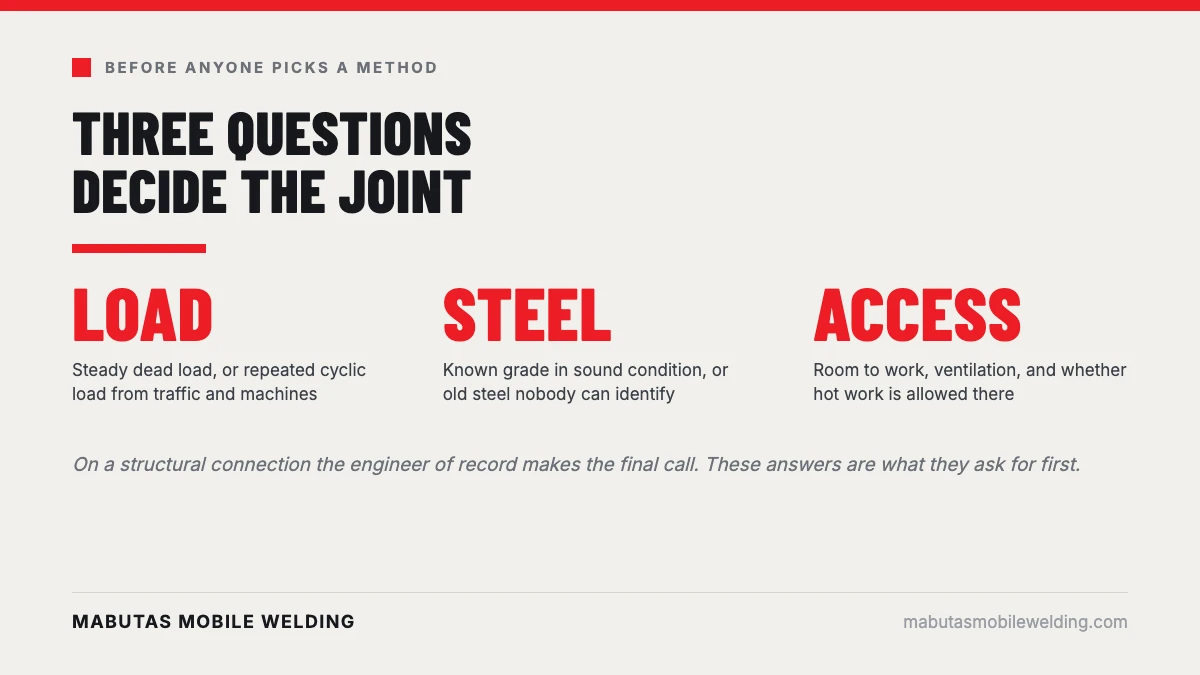
On paper the choice comes down to load. On a real job it often comes down to what the location allows. Walk the site with these in mind before anyone picks a method.
Older steel is not always the steel you would buy today. Its chemistry may be unknown, and higher carbon content makes steel harder to weld without cracking beside the bead. If nobody knows the grade, testing a sample or finding the original records settles it, not a guess.
Look hard for section loss at the joint. Rust at a connection often hides between plates or under a base plate, and a new weld on thinned metal tends to fail beside the bead instead of in it. Paint, primer or galvanizing has to come off wherever the weld goes, and we covered that prep separately in what changes when you weld galvanized steel. Welding heat also moves steel, and residual stress can pull a member out of line. If the cracked part is a machine or attachment rather than a building frame, how a cracked bucket gets judged for repair or replacement covers that side.
Then the point that decides jobs: on a structural connection, the method is the engineer of record's call, not the welder's. AWS D1.1 has a full clause on strengthening and repairing existing structures, and it starts from an evaluation of the existing steel. Whether a member can stay loaded while it is welded is a separate engineering question again. A good fabricator will say so before you ask.
The most common field instinct on a connection that looks weak is to bolt it and run a bead around it too. It rarely works the way people expect. A weld is stiff, and a bearing bolt needs a little movement before it picks up its share. In a shared joint the weld takes nearly all the load until it cracks, and only then do the bolts start working. The two do not add together.
When high-strength bolts and fillet welds end up in the same connection, usually as the result of remedial work, the RCSC commentary points the designer to the steel specification's section on bolts in combination with welds (AISC 360, Section J1.8). That section allows the two to share load only in narrow, specified cases, and deciding whether a joint qualifies is design work. If a bolted connection looks undersized, the fix is a designed connection, not an extra bead.
Ease of inspection is a real selection criterion, and it is one reason engineers often lean toward bolts in the field.
Welds get a visual inspection first: size, profile, undercut, porosity and surface cracks. Where the engineer calls for it, nondestructive testing follows. Magnetic particle testing (MT) finds cracks at or just under the surface, which is where fatigue cracks show up. Ultrasonic testing (UT) looks inside a groove weld for lack of fusion and buried flaws. Both take a qualified inspector and time on site, so they belong in the plan from the start.
Pretensioned bolts are checked by confirming they reached pretension. The RCSC specification recognizes installation methods including turn-of-nut, calibrated wrench, twist-off tension-control bolts and direct tension indicator washers. Each leaves something an inspector can verify: match marks, a sheared spline, a compressed indicator. That is a quick check next to UT, and it is part of why owners like bolted field connections.
In the industrial parks around Addison, Bensenville, Wood Dale and Itasca, the connections that raise this question are things like a dock leveler frame or door jamb that trailers keep hitting, a rack upright a lift truck caught, a mezzanine beam seat or a stair stringer that has pulled at its landing, a bollard or guard at a column that took a hit, a canopy or equipment support that has started to move.
Most of those are repeated or impact loads, which pushes the answer toward a bolted repair or a carefully detailed weld rather than a quick bead. Office and retail buildings in Elmhurst and Carol Stream bring the other version: an occupied building where any hot work runs through the property's own hot-work permit process, and a bolted fix may avoid it entirely. Neither version gets decided from a photo. It gets decided by looking at the load, the steel and the location together.
Call when the connection is cracked, bent, pulling away or has been hit, and when you want the method decided alongside someone who does this work in the field. On-site structural welding for DuPage County builders and GCs covers welded repairs, field modifications and new connections. A bolted retrofit usually needs a plate, clip angle or gusset made to fit the existing steel, and that is custom steel fabrication for DuPage contractors and property owners.
Stop and bring in an engineer first when the connection carries a primary structural load, when the steel grade is unknown, when the load is repeated, or when the building has no drawings. That is not a way out of the job. On a structural connection it is the right order of operations. Which welding process makes the weld is a separate question, covered in TIG vs MIG vs stick for field repairs.
When the two parts are different metals, the weld brings its own corrosion problem, covered in welding stainless steel to carbon steel.
Where the connection sits inside an occupied building, how a hot work permit and fire watch fit around the weld decides when the work can start.
When the member is already holding weight, welding to steel under load covers shoring, heat and who signs off.
Taking material out of a beam web changes its capacity too, and what a trade can cut in existing steel and what needs an engineer draws that line.
Send photos of the connection and get a quote
Sources: American Welding Society, AWS D1.1/D1.1M Structural Welding Code, Steel · Research Council on Structural Connections, Specification for Structural Joints Using High-Strength Bolts (2020)