
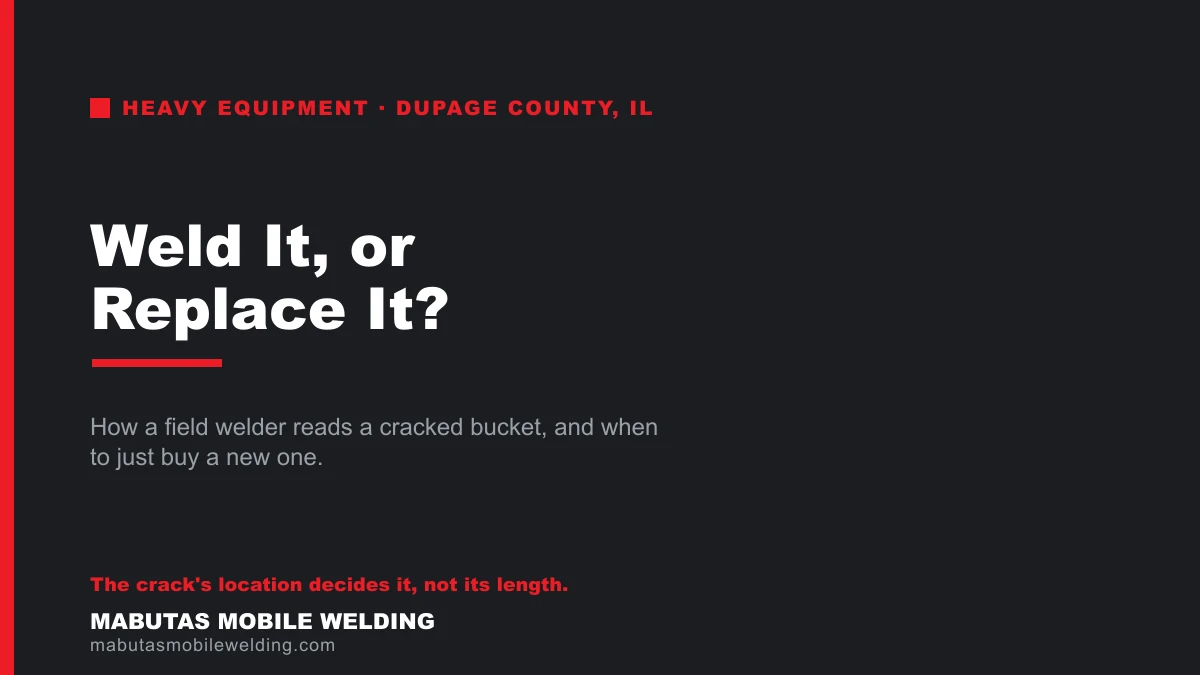
Whether you weld a cracked bucket or replace it comes down to where the crack is and whether the base metal underneath is still sound, not how long the crack looks. Weld-repair wins most of the time. Replace is the right call in a few specific cases. Here is the short version:
Here is what most "how to fix a cracked bucket" answers online get wrong: they either argue welding technique on a forum with no sense of when it is worth doing, or they run a "5 things to consider" list that exists to sell you a new bucket. Neither one gives you the actual decision. A cracked bucket is not automatically scrap, and it is not automatically a quick weld either. The call turns on two things you can read in about five minutes at the machine: where the crack is, and whether the steel around it is still sound. Get those right and you stop either throwing away good buckets or chasing cracks that keep tearing back open. This is how a field welder makes that call, and what the repair actually involves when the answer is weld it.
Before you price a new bucket or call anyone, walk the machine and answer four questions. Each "yes" pushes you toward replace. Mostly "no" means you have a weld candidate.
If you answered "no" to most of these, you almost certainly have a weld-repair, and probably a same-day on-site one. If two or more are "yes," get a replacement price before you spend anything on welding.
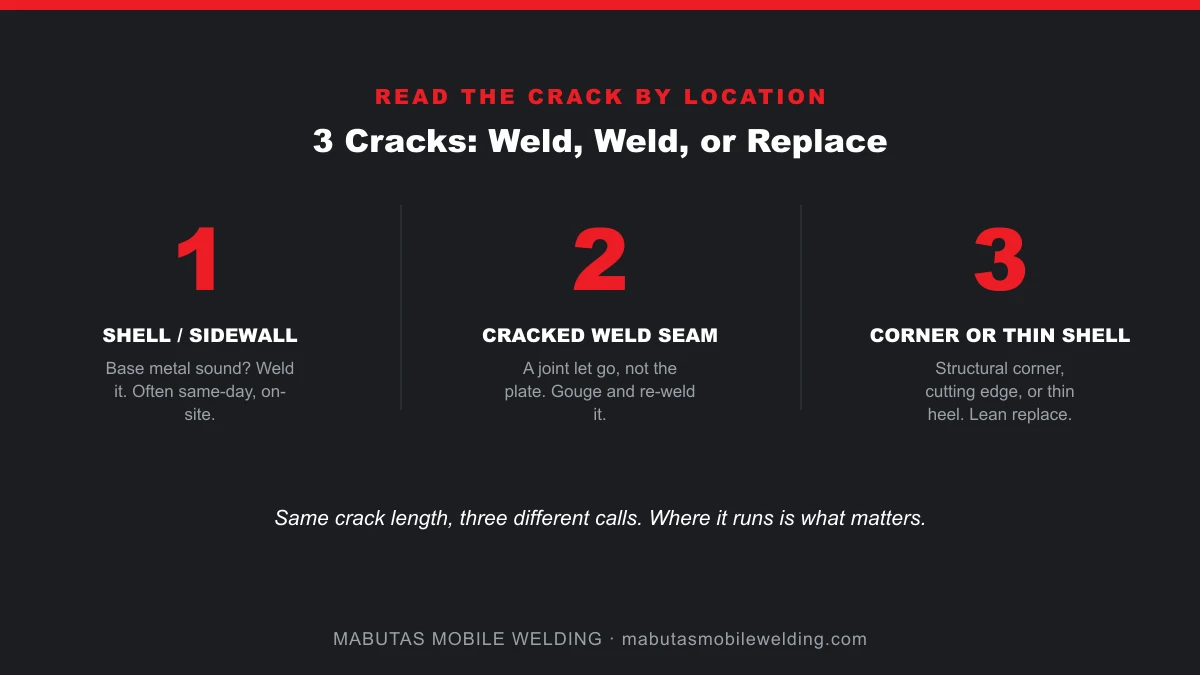
Crack length is the wrong thing to fixate on. A two-foot crack in the shell is routine; a two-inch crack in the wrong corner can total a bucket. Here is how each location reads.
Match your crack to the list above before you talk cost. The shell and seam cracks are your "weld it" majority. Corners, lip, and a worn-thin heel are where "replace" lives.
When the answer is "weld it," here is what a correct field repair looks like, so you know whether the work being done to your bucket is the real thing or just a cosmetic bead. Skipping any of these is why cheap weld jobs tear back open.
Because the truck carries the grinder, the gouging setup, preheat, and the welder, all of this happens at your yard or jobsite. That is the difference between the machine being down for hours versus days.
Match what you found to the correct call. This is the honest matchup, not a "buy a new one" list.
| What you found | The call | Why |
|---|---|---|
| Crack in the shell or sidewall, base metal beside it still sound thickness | Weld-repair (often same-day, on-site) | Straightforward gouge-and-weld into solid parent steel. The most common and cost-effective outcome. |
| Cracked weld seam, plate on both sides is intact | Weld-repair (re-weld the joint) | The weld failed, not the bucket. Gouge out the old weld, lay a new full-strength one, hardface if it is a wear face. |
| Crack in the heel/wear area with meat still left in the plate | Weld-repair, plus wear plate | Repair the crack and add abrasion-resistant wear strips so the fix lasts. Read thickness first. |
| Shell or heel worn paper-thin around the crack | Lean replace (or rebuild) | Nothing solid to weld to. Welding worn-out steel just relocates the crack. Consider a shell rebuild only if the rest is sound. |
| Crack through a structural corner or gusset | Get an assessment before welding | Sometimes reinforceable with plate, often a sign the bucket is overstressed or near end of life. Do not just weld it shut. |
| Crack into the lip casting or cutting edge; worn tooth adapters | Replace the component / lean replace | High-load, often cast or high-carbon parts. Adapters and edges are replaced and re-welded, not crack-chased. |
| Same crack has been welded before and returned | Replace | Returning cracks are fatigue. Another weld buys weeks, not years. The part is telling you it is done. |
A note on the steel. Buckets are built from abrasion-resistant (AR) plate, hard steel in roughly the 350 to 500 Brinell range depending on grade. That hardness is exactly why preheat, low-hydrogen filler, and controlled cooling matter. Weld hard plate cold and fast and you get a brittle heat-affected zone that cracks on the next dig. Get the process right and a shell repair can outlast the rest of the bucket.
The repair-vs-replace decision is really a money decision, so put real numbers on both sides before you choose.
Cost of downtime. Add up what the idle machine costs per day: the operator standing around, the rented machine still on the clock, the crew and subs waiting on that hole to get dug, and the schedule slipping toward liquidated-damages territory on a deadline job. For a working excavator on an active DuPage site, a day down is rarely cheap, and it is often the biggest number in this whole equation.
Cost of replacement. A new bucket is not just its price tag. It is the price plus lead time, and lead time is the killer. If the correctly-sized bucket has to be ordered and shipped, you are down for those days no matter what you spend. Trucking the machine or the bucket to a shop and back adds its own days on top.
The comparison that usually wins. A same-day on-site weld repair collapses that downtime to hours. Even when a new bucket eventually makes sense (a worn-thin, end-of-life bucket), a fast field weld can keep you digging this week while the replacement is on order. The question is almost never "weld or replace forever." It is "what keeps this machine working through the deadline," and a same-day repair usually answers it.
A good field welder will also tell you when NOT to weld. Welding the wrong thing, or welding in the wrong conditions, is how a bucket fails under load or how someone gets hurt. Stop and reassess when:
Short version: weld the shell and the seams when the metal is sound, and walk away from fatigue-cracked, worn-out, or safety-critical parts. A welder who will tell you to replace something is worth more than one who welds everything.
There is one more local factor worth naming. DuPage County ground works buckets hard, especially in the cold months. Frozen and frost-bound soil digs like rock, and prying frozen material loads the shell and heel far past what summer digging does. That is exactly the loading that starts shell and heel cracks, which is why cracked buckets show up in clusters after a hard freeze.
When that happens on a running job, the last thing you want is to pull the machine off the site and truck it to a shop. Our on-site heavy equipment welding and repair service in DuPage County brings the shop to your yard or jobsite, so the machine gets fixed where it sits and never loses a day to transport. If the crack has run past the bucket into frames, cross-members, or brackets, that is the same on-site truck and crew, covered under our on-site structural welding work. Either way, the machine stays on your site and keeps digging the same day.
Most cracked buckets I get called out to, the steel's still good. It's a shell crack or a weld seam that let go, and I can gouge it, weld it, and hardface it right there in the yard before lunch. Where I'll tell a guy to buy new is when the same crack keeps coming back, or the plate's worn down to nothing, or it's cracked through a corner or the lip. That's fatigue, and no weld beats fatigue. I'd rather send you to a new bucket than sell you a repair that tears open on the next dig.
Don Mabutas, Mabutas Mobile Welding
A cracked excavator or loader bucket is a decision problem, and the decision is simpler than the forums make it. Read the crack by location: shell and sidewall cracks and cracked weld seams are weld-repairs when the base metal is sound, usually same-day and on-site. Structural corners, the lip and cutting edge, a worn-paper-thin shell, and any crack that keeps coming back lean toward replacement. Then put money on it: a day of downtime versus a new bucket plus its lead time, and a fast field weld almost always keeps you digging while you decide. Done right the repair is clean, stop-drilled, gouged to sound metal, preheated, filled with low-hydrogen, and hardfaced. Done wrong it is a bead over a gap that fails next week.
A crack at a connection on a building frame, rather than on a machine, is a different decision. How welded and bolted structural connections compare covers steady versus repeated load and who makes the call on the method.
Once the bucket is welded, the next question is what the repair will carry and where it will crack next. How strong a welded repair is under steady and repeated load answers that without a formula.
Whether a cracked bucket can be repaired in the yard or has to come off for a shop is covered in what can be welded in the field and what has to go to a shop.
Other commercial-yard steel gets the same repair-or-replace decision, such as a steel bollard a truck has damaged.
Text a couple of photos to 312-324-4832, one close-up of the crack and one of the whole bucket, or request a quote online. You'll get a straight answer: whether the steel is sound, whether it is a same-day field weld or a replacement, and what it will cost, with the welder coming to your DuPage County yard or jobsite.
Get a Fast QuoteSources: FHWA, repair and retrofit of fatigue cracks in steel · Abrasion-resistant wear plate hardness ranges and bucket applications · OSHA, welding, cutting, and brazing safety · American Welding Society
We do equipment repair on site in Wood Dale as well.