
The bucket is welded, the trailer tongue is welded, the rack upright is welded, and the person who owns it asks the same thing every time: is it as good as it was? Search how strong is a welded repair and page one hands you epoxy reviews and calculators for sizing a brand new joint. Neither answers the question an owner is asking about a repair that already exists. The honest answer has two halves, and the second half is the one that breaks trailers and buckets.
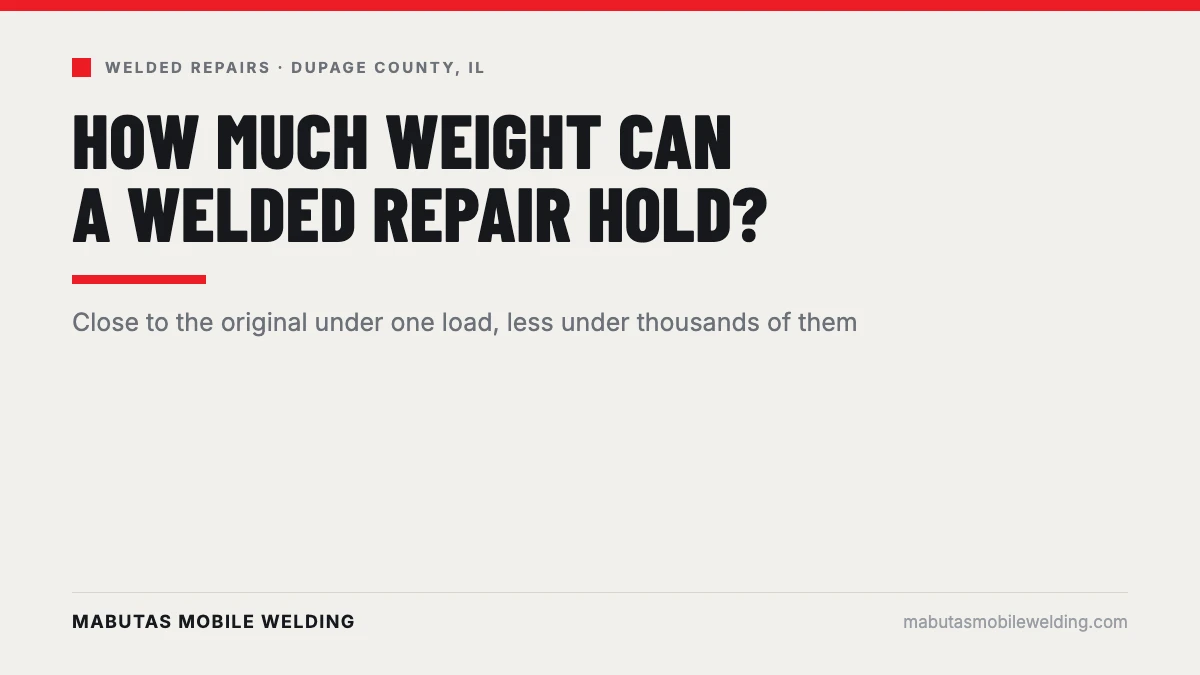
A repair that was prepared and fused properly can carry close to what the surrounding metal carried under a steady load. Under repeated load it gives up some of its life, because the repair itself is where the next crack wants to start.
Much of what comes back for this question is about a two-part epoxy. That is a bonding product with a tensile figure printed on the tube, fine for a non-structural patch, a seal or a cosmetic fill. It is not fused metal. A weld melts the base metal and the filler together into one continuous piece of steel. If the part carries weight, moves under load or gets hit, that is the repair you want, and the numbers on an epoxy tube do not transfer to it. Everything below is about welds.
People say "strong" and mean two different things, and mixing them up is how a repair that held on day one fails a month later.
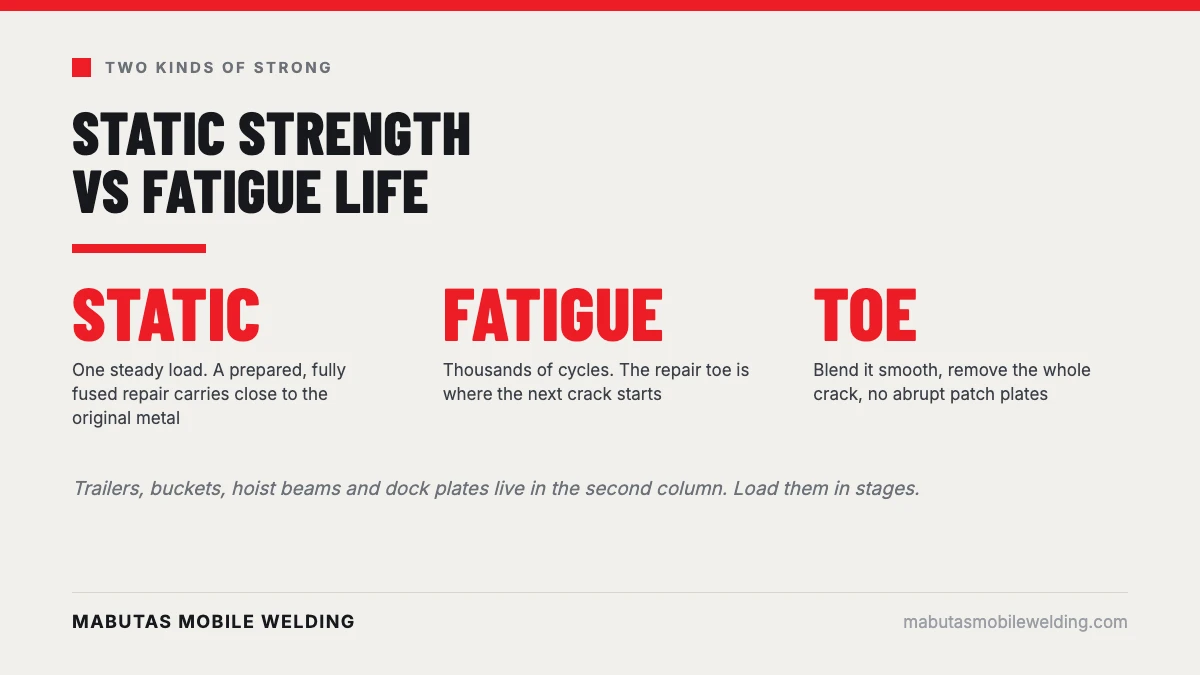
Static strength is one steady load. Will the repaired member hold the weight sitting on it right now. A shop stand, a column base plate, a bracket holding a sign. Steady loads are where a sound repair does its best work.
Fatigue life is thousands of load cycles. Not will it hold once, but how many times before a crack starts again. A trailer frame on the highway takes a cycle every bump. A bucket curling into a pile, a hoist beam, a dock plate, a rack upright that gets bumped all shift, a hitch on a lawn-crew trailer loaded and unloaded every day. Those are cyclic assets, and cyclic load is where welded repairs give up ground.
Put your own asset in one of those two buckets before you read further. If it lives in the second one, the rest of this post matters more than any single number would.
You do not need a formula for this. You need to know what was done, and most of it can be seen or asked about.
The honest headline: a properly executed repair can develop close to the strength of the surrounding metal. A bead run over an unprepared crack develops almost none of it, and hides the crack while it does. The AWS D1.1 structural welding code is built around that difference: its repair and acceptance provisions are about preparation, fusion and profile, not about the size of the bead.
| Asset | How it is loaded | What a sound repair restores | Where it fails next | Check before loading it |
|---|---|---|---|---|
| Trailer frame rail or crossmember | Repeated, every bump on the road | Close to original static capacity | At the toe of the repair, or where a patch plate ends | Crack ends gone, weld blended, no undercut, member straight |
| Trailer tongue or hitch | Repeated plus shock at the coupler | Close to original if fully fused through the section | Beside the weld in the heat-affected metal | Full-section fusion, matched filler, no thinning from rust |
| Excavator or loader bucket and its ears | Repeated, impact and abrasion | Close to original on the ears; wear areas keep wearing | Same crack line, if the old crack was not fully removed | Old crack gone, ears aligned, pins fit without forcing |
| Rack upright or shelf beam | Mostly steady, with impact from lift trucks | Close to original static capacity on a straight member | Where the upright was bent and straightened | Upright plumb, no kink left in the column, footplate anchored |
| Dock plate or leveler frame | Repeated, trailer after trailer | Close to original if the frame is still square | At the hinge and lip welds | Frame square, hinge pins seated, no cracks at the lip |
| Gate or fence frame | Mostly steady, wind and swing | Close to original | At the hinge post weld | Gate swings without binding, post plumb, weld blended |
| Lifting eye, hook, sling point, hoist component | Life-safety load | This is not a field-repair decision | Anywhere, without warning | Do not field-repair it. See the testing section below |
This is the part that decides whether your trailer or bucket comes back.
Every weld adds heat, and heat adds residual stress as the metal cools. The toe of a weld, where the bead meets the base metal, is a stress riser. The heat-affected zone beside it is metal whose properties changed when it got hot. A repair stacks all of that onto an area that was already welded once. None of it shows up under a steady load. Under repeated load it is exactly where the next crack starts.
The research backs this up. In a peer-reviewed test series on structural steel T-joints, repair-welded joints showed lower fatigue life than the original welded joints under the same cyclic load, and repairs made at the weld toe lost more life than repairs made elsewhere. Static tensile strength came back to within a small margin of the original. That is the pattern across the literature: the strength returns, the fatigue life does not fully return.
What reduces the loss: removing every bit of the old crack, grinding the toe smooth so the weld blends into the base metal, a correct profile with no undercut, and letting the member move rather than boxing it in with a stiff patch. What makes it worse: welding over the crack, stacking passes to fill a gap that should have been opened up, a hard patch plate that ends abruptly and creates a new stress riser beside the repair, and welding the same spot for the third time. If it has cracked twice in the same place, the fix is not a third weld.
You are deciding whether to trust it with a load, and that is a fair thing to do with your own eyes.
What a visual check cannot tell you is what is under the surface: lack of fusion inside a joint, a buried crack, porosity in the root. That is what testing is for.
Nondestructive testing, in plain terms. Dye penetrant pulls a colored dye into surface cracks too fine to see. Magnetic particle testing finds cracks at and just under the surface on steel, which is where fatigue cracks live. Ultrasonic testing sends sound through the joint and finds what is inside: lack of fusion, buried flaws, cracks that have not reached the surface yet. On a critical member the specification, not the welder, decides what testing is required.
Then the line that matters most. Lifting gear, hooks, lifting eyes, sling points, crane and hoist components, and anything a person rides on or stands on belong to a different category. Federal rules are blunt about it: OSHA 1910.184 on slings says damaged or defective slings shall not be used, and cracked hooks and components come out of service. A repair there is a manufacturer or engineer question, and the right answer from a welder standing in front of a cracked hook is no. Be suspicious of anyone who says yes.
In DuPage County the assets this applies to are practical ones: lawn-crew and equipment trailers in Lombard and Villa Park, dump-trailer hinges and gates, buckets and thumbs on compact excavators, rack uprights in Carol Stream warehouses, dock plates and leveler frames in Wheaton, hitches and receivers on working trucks. On the estate side in Hinsdale and Oak Brook it is more often equipment kept on the property, a gate frame or a piece of yard steel.
A mobile rig can do most of that where the asset sits: grind the crack out, open the joint, weld it in passes, blend the toe and check the alignment. What a rig cannot do is turn thinned, rusted metal back into sound metal, or make a lifting component safe again. Those are replacement conversations.
On capacity grounds alone, three things point to replacement: a member that has lost real section to rust or wear, a member that has cracked more than once in the same place, and any critical lifting component. Everything else is usually a repair question. Whether the repair is worth the money against a new part is a different calculation, and how a cracked bucket gets judged for repair or replacement walks through it. Whether a cracked frame can be welded in the first place is covered in what a proper trailer frame crack repair involves, and if you are still deciding between a welded and a bolted fix on a structural member, start with welded versus bolted connections under load.
When the asset is a bucket, boom, attachment or machine frame, that is on-site heavy equipment repair across DuPage County. When it is a frame, tongue, ramp or crossmember, it is mobile trailer repair in DuPage County. Bring the question about load with you. A welder who will not talk about fatigue is not the one you want on a trailer.
If the repaired member is a handrail post or base plate on a commercial stair, how to tell if a commercial handrail is structurally sound covers the walk-through.
How a repair performs once it is made is one question, and whether it can be welded on a loaded beam at all is another.
A repair is one way steel gets altered, and a new opening is another; for the second, see cutting holes in an existing steel beam, and for steel posts hit by vehicles, repairing or replacing a damaged bollard.
Send photos of the repair and get a quote
Sources: American Welding Society, AWS D1.1/D1.1M Structural Welding Code, Steel · Influence of Repair Welding on the Fatigue Behavior of S355J2 T-Joints (Materials, via PubMed Central) · OSHA 29 CFR 1910.184, Slings