
An inspection walk-through, a tenant complaint or a near miss on a stairwell puts fourteen handrails on your list and one question next to each of them: is my handrail structurally sound, and how do I tell without hiring a testing lab for every one? Page one for that question is testing labs on one side and homeowner listicles about squeaky wooden stair rails on the other. Nothing in the middle is written for the person with a clipboard, a building and a budget. This is that page.
Sound means the rail resists the load the code requires without permanent movement or failure. Most rails that fail do not fail in the rail. They fail where they are attached.
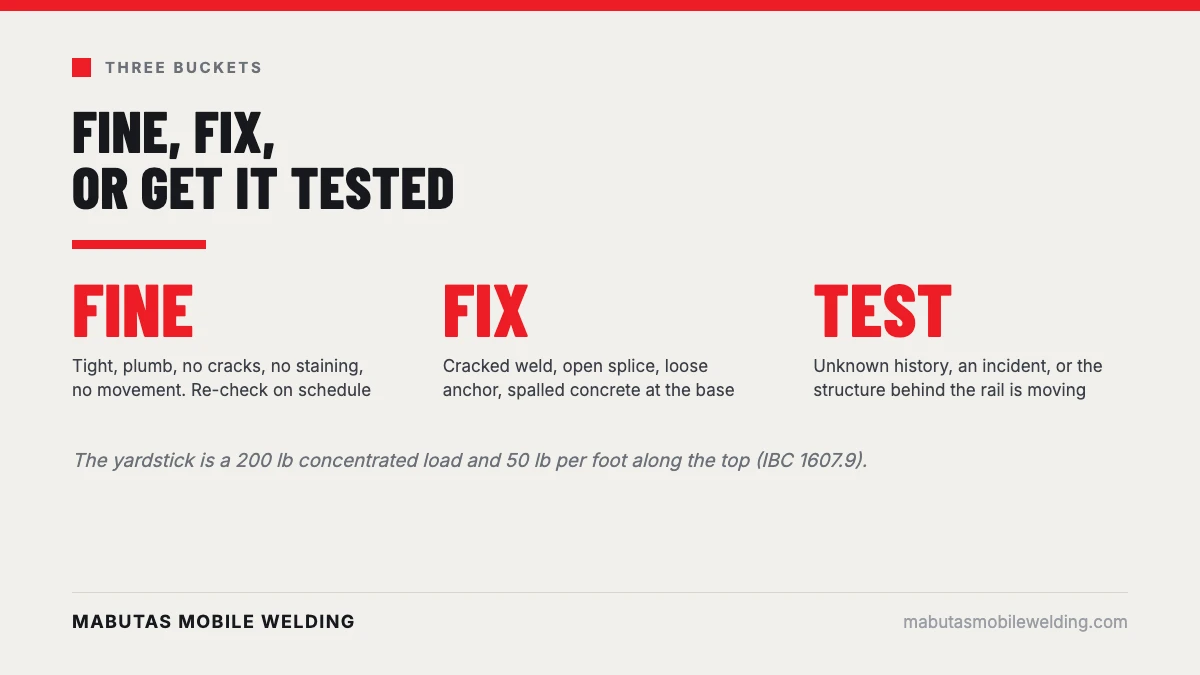
Soundness is not a feeling you get when you grab the rail. It is a published load. The International Building Code, Section 1607.9 requires handrails and guards to resist a concentrated load of 200 pounds applied at any point along the top in any direction, and separately a uniform load of 50 pounds per linear foot along the top, without failure. Infill and intermediate rails carry their own 50 pound requirement. For workplaces, OSHA 1910.29 says the same thing in its own words: handrails and top rails must withstand at least 200 pounds applied downward or outward within two inches of the top edge.
Which requirement governs a given building depends on its occupancy and on the code edition adopted where it stands, so treat those figures as the yardstick, not as a ruling on your property. The point is that "is it sound" has a definition. A rail either resists that load without permanent deflection or it does not.
This is the reframe the whole walk-through turns on. Steel pipe and tube do not usually break. What breaks is the connection between the rail and the building: the anchor into concrete or masonry, the base-plate weld, a fastener into a substrate that has crumbled, a post embedded at grade that has rusted through where it enters the slab, or a splice in a long run that has opened up.
That matters for a second reason. When the top of a rail moves, it can mean the rail is loose. It can also mean the structure the rail is bolted to has moved: a stair nose that has broken off, a slab edge that is spalling, a landing that has settled. Those are different problems with very different costs, and the walk-through below separates them.
Run the same sequence at every rail and write down what you find. It does not take a welder to do this. It takes attention and a consistent order.
Then record it: location, what was found, and which of the three buckets below it goes in.
| What you find | What it usually means | Bucket | Who does it |
|---|---|---|---|
| Rail moves at the top, anchors are tight, concrete is sound | A loose or cracked base-plate weld, or a bent post | Fix | Welder |
| Anchor loose or spinning in the concrete | The anchor or the hole has failed, not the rail | Fix | Anchoring, then welder if the plate is damaged |
| Concrete cracked or spalled around the anchor | Substrate failure; the rail will not stay tight | Fix, concrete first | Concrete contractor, then re-anchor |
| Visible crack at a weld or base plate | The connection is carrying load through a crack | Fix now | Welder |
| Splice or joint separated | Continuity is broken; load has nowhere to go | Fix now | Welder |
| Section loss or scaling at the base | The post has thinned where it carries the most | Fix or replace, depending on how much is left | Welder assesses |
| Rail already repaired once at the same spot | The cause was not addressed | Get it tested or replace | Engineer or testing service |
| Rail missing, short, or terminating in mid-air | A code and safety gap, not a strength question | Fix | Welder |
| Whole assembly moves with the structure behind it | The stair, slab or landing is moving, not the rail | Get it tested | Engineer first |
| Tight, plumb, no cracks, no staining, no movement | Doing its job | Fine | Re-check on schedule |
A push tells you a rail is bad. It does not tell you a rail is good, because you are not applying 200 pounds in a controlled direction and measuring what comes back. A proof load test does exactly that. ASTM E935 is the test method for the performance of permanent metal railing systems and rails in buildings, and it is what a testing service works to when an owner needs evidence rather than an opinion.
Order a test after an incident, on a rail whose history is unknown, when an insurer or the authority having jurisdiction has asked for documentation, or on a large retrofit where the real question is whether the anchors into old concrete will hold. That is not a welder's call, and it is not something we do. A welding contractor fixes what the test or the walk-through finds. Naming that boundary is the honest version of this page.
A cracked base-plate weld, a separated splice, a picket that has let go or a post that needs a new plate is a welding repair, done in place with the rail staying where it is. The connection is rebuilt to carry the load, the weld is blended and checked, and the rail goes back into service.
A sound rail on a failed anchor is an anchoring and substrate problem. New anchors into spalled concrete do not hold, so the concrete is addressed first and the rail is re-anchored after. Sometimes that is a bigger base plate spanning sound concrete; sometimes it is patching the slab edge.
A rail with real section loss through the base, or one that was never anchored to carry the code load in the first place, is a replacement conversation. That is handrail and railing work for DuPage County commercial properties, and it starts with the same walk-through record you just made.
Nothing else on this search has this section, and it is the part that protects you. For each rail: the date, the location (which stair, which flight, which side), what was observed in plain words, which bucket it went in, what was done and by whom, and the date it gets re-checked. A photo of anything in the fix or test buckets. Twice a year is a reasonable baseline for a walk-through; exterior rails, loading docks and the busiest stairwells earn a look every season, because that is where the damage happens fastest.
This is a maintenance record, not a legal document. It does not need to say anything about liability, and it should not. It needs to show that someone looked, what they saw and what happened next.
Freeze-thaw cycling through an Illinois winter is hard on exactly the joint this post is about: the place a steel post meets concrete. Water sits there, freezes, expands and opens the concrete a little more each cycle. Deicing salt tracked onto exterior stairs, ramp rails and dock stairs corrodes the post at grade and the anchor inside the hole. By spring the rail that was tight in October is loose, and the concrete around the anchor is on its way out.
The buildings that show it first are the ones with the most exterior steel and the most traffic: the industrial and warehouse properties around Bensenville, Addison and Itasca with dock stairs and ramp rails, the office and medical buildings in Oak Brook and Naperville with exterior stoops and parking-deck stairs, and the multi-tenant properties in Elmhurst that have taken twenty winters of salt. A mobile rig fixes the rail where it stands, without the rail leaving the property or the stairwell closing for a week.
Call when the walk-through turns up anything in the fix bucket: a cracked weld, a separated splice, a post that has let go, a base plate that needs rebuilding. On-site welding for DuPage County commercial properties covers that repair on stairs, ramps, docks and stairwells, in place, in an occupied building, with the hot-work arrangements settled with the property before the truck rolls. Where the walk-through says the structure behind the rail is what is moving, it needs an engineer before it needs a welder, and the right contractor will tell you so. For what the code requires a railing to be in the first place, heights, gaps and graspability, see the Illinois stair, deck and balcony railing code guide. If the rail in question is one exterior iron railing at your own front steps rather than a building full of them, how to tell whether a loose exterior iron railing is safe is the page written for you.
Where the finding is a repaired weld at a base plate or splice, what that repair will carry is covered in how strong a welded repair is.
If a repair on a stair or landing has to be welded in place, the hot work permit and fire watch steps for an occupied building come first.
If the rail is sound but short rather than loose, the balcony railing height code explains which height governs.
Send photos of the rail and get a quote
Sources: International Code Council, 2021 International Building Code, Chapter 16, Section 1607.9 Handrails and Guards · OSHA 29 CFR 1910.29, Fall Protection Systems and Falling Object Protection · ASTM E935-21, Standard Test Methods for Performance of Permanent Metal Railing Systems and Rails for Buildings · American Welding Society, AWS D1.1/D1.1M Structural Welding Code, Steel