
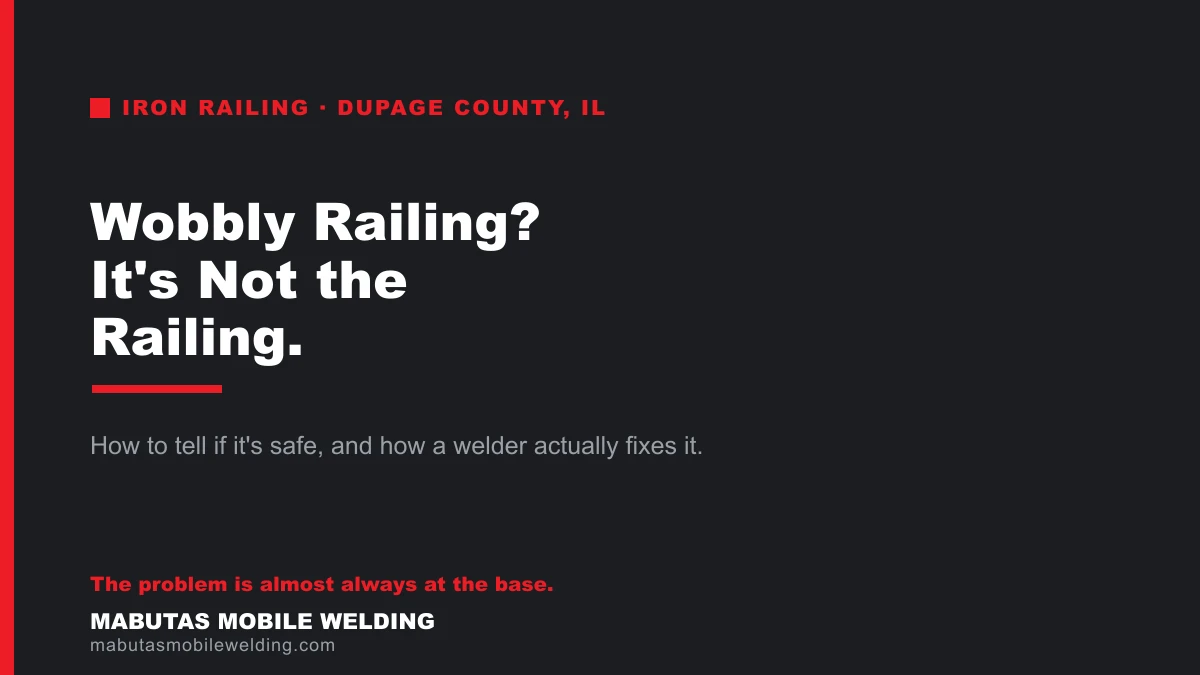
A loose or wobbly exterior iron railing is almost never the railing itself. It's the connection to the ground. By the time the top rail moves, the failure is down at the base: a rusted base plate, corroded anchors, or a cracked weld at the foot of the post. Here is the short version:
Here is the thing almost every "how to fix a wobbly railing" answer online gets wrong: they treat the railing like the problem and tell you to epoxy it. But a wrought iron railing is a stiff welded assembly. It does not get wobbly in the middle. When the whole thing rocks, the metal up top is just the handle you feel it through. The real failure is six inches off the ground, where the post meets the plate and the plate meets the concrete. Get that diagnosis right and you stop wasting money on fixes that fall out by spring. This is how a welder actually reads a loose exterior iron railing, and what the correct repair is for each cause.
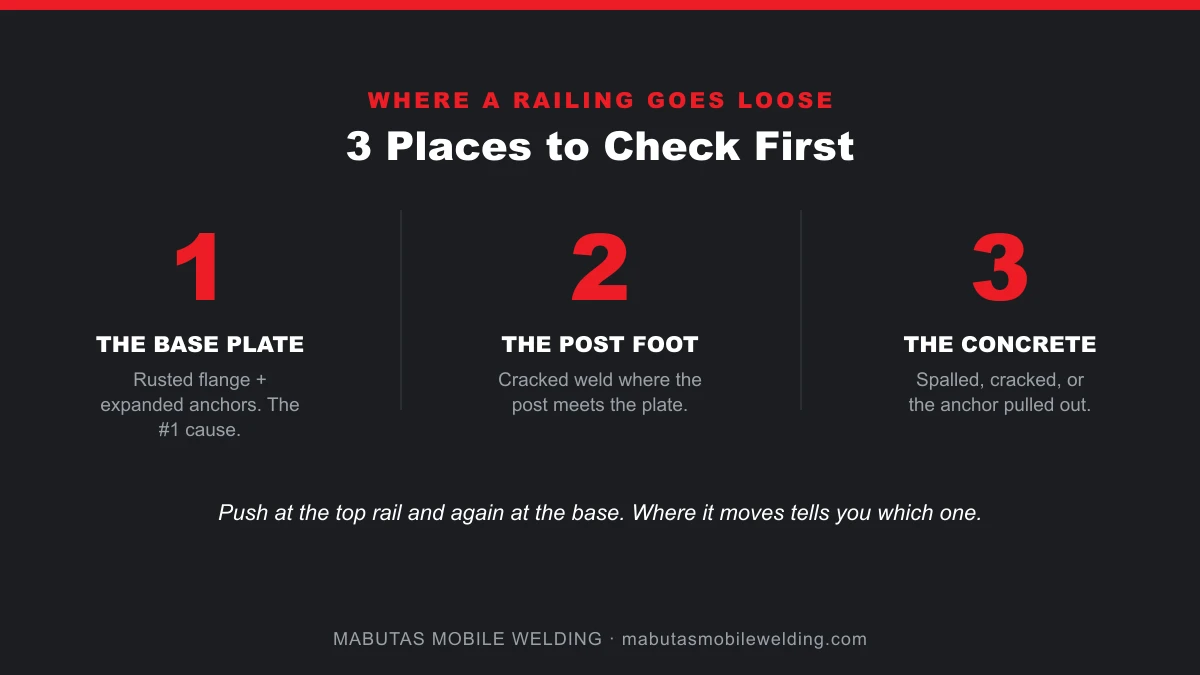
Before you call anyone, you can locate the failure yourself in under a minute. You need your two hands.
Read the result:
Two more quick checks while you are down there: run a finger under the base plate for flaking rust or a brown stain bleeding out from under it (that is corrosion working from the inside), and look at the weld line where the post sits on the plate for a hairline crack or a rust seam. Those two spots tell you almost everything.
Nearly every wobbly railing traces back to one of these five. Here is what each one looks like so you can match yours.
Most real-world railings have two of these at once, because they share a cause, which is the next section.
If you are in DuPage County, your railing did not just wear out. It was attacked on a schedule, every winter, by the two things this climate does best.
Here is the failure pattern we see over and over on exterior stairs from Villa Park to Naperville:
This is why a railing on the salted, sun-and-shade north side of a stoop fails years before the same railing on a sheltered patio. It is also why a surface fix does not last here: if you epoxy or paint over the top without cleaning the salt and corrosion out of the joint, you have sealed the problem in. The chloride keeps working. This is the part every generic guide skips, and it is the whole reason "just epoxy it" fails in this climate.
The right repair depends entirely on which of the five you have. Here is the honest matchup, with what the work involves.
| What you found | The correct fix | What it involves |
|---|---|---|
| Loose or corroded anchors, plate and welds still sound | Replace the anchors | Back out the failed bolts, clean the holes, set new corrosion-resistant (stainless or hot-dip galvanized) wedge or sleeve anchors sized to the plate holes. The one case where a mechanical/epoxy-set anchor is the right permanent answer. |
| Anchor holes in the concrete are enlarged or spalled around the bolts | Epoxy-set anchors in widened, cleaned holes | Drill out to sound concrete, vacuum the dust (epoxy will not bond to dust), inject a structural anchoring epoxy, set threaded rod or anchor, let it cure fully before load. Epoxy bonds the anchor to the concrete. It does NOT fix steel. |
| Rusted-through base plate OR cracked weld at the post foot | Cut and re-weld | Cut off the failed plate or grind out the cracked weld, fabricate and weld on a new base plate (typically 1/4-inch steel or heavier), re-establish a full-strength weld at the post foot, then re-anchor. This is a welding job. There is no glue substitute. |
| Post set in a spalled/oversized cored hole in concrete | Re-anchor the post | Clean the pocket to sound concrete, then either non-shrink structural grout the post back in, or (better) fabricate a base plate onto the post and surface-mount it to a repaired, sound area of slab. |
| Post leaning from frost heave, footing has moved | Reset the footing | The metal is fine; the ground failed. Reset or re-pour the footing below the frost line and re-mount. A weld repair on a heaved footing just re-breaks next winter. |
A note on materials and load. Whatever the fix, the finished joint has to do a real structural job, not just stand there. A guardrail or handrail is expected to resist a single concentrated 200-pound load applied in any direction at the top rail. That is why anchor grade, plate thickness, and weld quality matter. New anchors should be corrosion-resistant (stainless or hot-dip galvanized) so the salt does not eat the repair in three years. A replacement base plate is commonly 1/4-inch steel or heavier. Get any of those wrong and the railing passes the shake test today and fails the code load in an emergency.
There is a clean line between what a careful homeowner can do and what needs a welder, and it is not about pride. It is about what happens if the railing lets go when someone grabs it on ice.
You can reasonably DIY: replacing loose surface anchors on a sound plate and sound concrete, on a low porch or a step or two where a fall is short. Clean, correct anchors, snug them down, done.
Stop and call a pro when any of these are true:
Short version: if it is a cracked weld, rusted-through steel, or anything guarding a fall over about 30 inches, epoxy is not the fix. A welder is.
The old way to fix a badly corroded railing was to unbolt or cut it loose, haul it to a welding shop, repair it on a bench, and bring it back another day. That means two trips, a stretch of days with no railing on your stairs (which is its own hazard), and often more damage getting the thing off and back on.
Mabutas fixes exterior railings on-site, in a single visit. The truck is the shop. We diagnose it at your steps, cut and re-weld the base plate or post foot right there, set new anchors, and you have a solid, code-worthy railing before we leave, no hauling anything anywhere. For a loose railing on a set of front steps that people use every day, single-visit on-site repair is not just more convenient, it means you are never left with an open stairway and no handrail.
Because this is on-site work by nature, the whole job happens at your steps. Our wrought iron and ornamental railing repair service in DuPage County covers everything in the fix table above. If the same corrosion has reached a connected fence run, that is a related trade: see wrought iron fence repair for DuPage County. And if you are weighing whether the ironwork is even worth saving, our guide to wrought iron repair vs replacement walks through that call.
Nine out of ten wobbly railings I get called to, the railing itself is perfectly good steel. It's the plate and the anchors at the bottom that rotted out, usually from salt. I'll show you the rusted-out spot before I touch it, re-weld or re-anchor what actually failed, and set it up so the next few winters don't just eat the repair. If somebody's telling you the whole railing needs replacing, get a second look first.
Don Mabutas, Mabutas Mobile Welding
A loose or wobbly exterior iron railing is a diagnosis problem, not a mystery. The wobble you feel at the top is almost always a failure at the bottom: a rusted base plate, corroded anchors, a cracked weld at the post foot, a spalled concrete pocket, or a heaved footing. Run the 30-second test to find which one, and understand that in this climate salt and freeze-thaw are usually why. Loose anchors on a low, sound porch can be a DIY fix. A cracked weld, rusted-through steel, or any railing guarding a real drop is a re-weld job that has to hold a 200-pound load, and that is a welder, not a tube of epoxy.
There is a material question sitting underneath all of this. If the base plate, collar or newel is a casting rather than wrought steel, an ordinary steel repair cracks straight back out beside the bead. Cast iron needs nickel filler and a slow cool, and on a railing set into concrete the preheat is the awkward part.
If you manage a building with a stairwell full of rails rather than one railing at your own steps, how to tell if a commercial handrail is structurally sound gives you a walk-through and a record to keep.
On an Elmhurst home, a loose railing is handled as wrought iron railing repair in Elmhurst, matched to the ironwork already there.
Text a couple of photos to 312-324-4832, one close-up of the base and one of the whole railing, or request a quote online. You'll get a straight answer: what actually failed, whether it's a fix or a re-weld, and what it'll cost, with the welder coming to you anywhere in DuPage County.
Get a Fast QuoteSources: 2021 International Residential Code, Chapter 3 (guards and handrails) · how de-icing road salt accelerates steel corrosion
Fences corrode on a different clock to railings, down at the ground line rather than at a base plate or a wall anchor. If it is a fence rather than a railing worrying you, start with how rust on a wrought iron fence gets diagnosed and fixed.
If the railing is on a Glendale Heights property, see mobile welding in Glendale Heights.
On a managed property the same loose railing has to be fixed with the building open and the work written up for whoever signs it off. That is what on-site handrail and guard repair in Itasca is built around.