
Here are the numbers most Illinois inspectors are checking, before we get into why they matter. Villa Park, DuPage County, and most Illinois municipalities build off the International Residential Code (IRC), so these are the working figures. Confirm the exact edition with your local building department.
Most railing problems are not a mystery. A rail either meets the height, closes the gaps, and holds the load, or it does not. The part nobody explains is that a rail can pass on height and looks and still fail on the one number you cannot see: the load it has to hold. That is where a store-bought bracket kit into old wood or crumbling masonry falls apart, and it is exactly where welded steel earns its keep. Here is the stair and deck railing height code in Illinois in plain numbers, then the honest line on when a bolt-on rail will not pass and you need steel.
Before any height matters, figure out whether you need a guard at all. A guard is the barrier along an open side. A handrail is the graspable rail you hold going up and down stairs. They are different parts with different rules.
So a low deck two steps off the lawn may need neither. A second-floor balcony or a deck 31 inches up needs a guard, full stop.
This is the most common inspection miss, so keep them separate.
Notice the overlap. On a stair you can have a 34-to-38-inch handrail you grip and a 34-inch-minimum guard that keeps you from going over the side. On a flat deck you just have the 36-inch guard. Getting a 36-inch guard but a handrail set at 42 inches, or a beautiful rail with no graspable handrail at all, is a classic failed inspection.
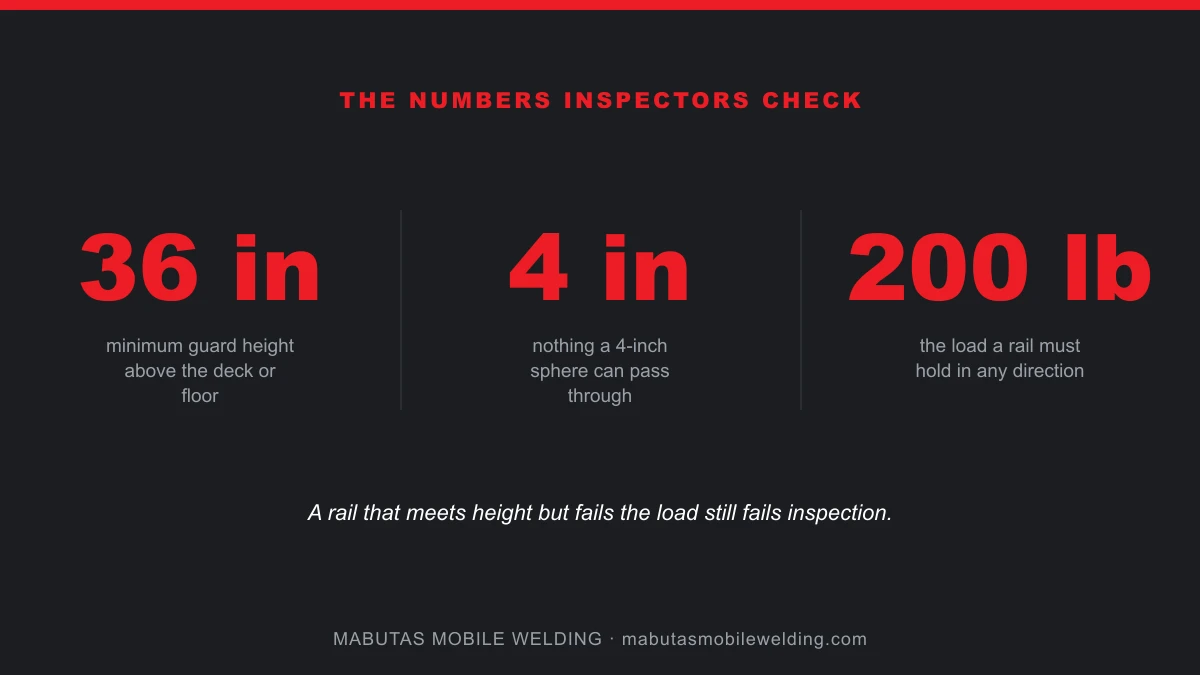
Guards cannot just be tall. They have to be closed enough that a small child cannot slip through. The test is a sphere, not a tape measure, because inspectors literally use a ball.
Stair rules also govern the handrail itself. It has to be continuous the full length of the flight, and the ends must return into the wall or a post or terminate at a newel so a sleeve or bag strap cannot catch on an open end. And it has to be graspable: a round rail between 1-1/4 and 2 inches in diameter, or an equivalent graspable profile. A flat 2x4 on edge is not graspable and does not pass.
Here is the rule that decides whether your rail is real or decorative.
Two hundred pounds sideways at the top of a rail is a grown adult falling into it. That is not a stress test, that is a Saturday. And that force does not stay at the rail, it travels down the post and into whatever the post is bolted to. A rail is only as strong as its weakest connection, which is why the load rule, not the height, is what usually decides between a bolt-on kit and welded steel.
Plenty of rails can be bolted on and pass. The decision only tips to welded steel when the connection or the setting cannot honestly carry that 200-pound load. Here is the threshold logic.
| Situation | Bolt-on kit | Welded steel | Why |
|---|---|---|---|
| New deck, sound framing, low fall height | Often fine | Optional upgrade | Solid wood + rated hardware can meet the 200-lb load |
| Posts landing on old, split, or rotted wood | Fails the load | Yes | A fastener is only as strong as what it bites into |
| Posts into brick, block, or crumbling masonry | Usually fails | Yes | Anchors pull out of soft or old masonry under side load |
| Balcony or second-story deck (high fall height) | Risky | Yes | Higher stakes, higher scrutiny, load must be certain |
| Commercial, multi-family, or high-traffic stairs | Rarely passes | Yes | Adds the 50-lb-per-foot load and inspector attention |
| Existing rail that already wobbles or moves | No, band-aid | Yes | Movement means the connection already lost the load fight |
| Historic or ornamental iron that must match | No | Yes, fabricated to match | Original ironwork gets repaired and matched, not swapped for a kit |
The pattern is simple. Bolt-on works when the thing you are bolting into is strong and new. Welded steel is the answer when the connection is the weak point, the fall height is serious, or the setting is commercial. A welded guard ties post to base to structure as one piece, so the 200-pound load has a continuous steel path to ground instead of resting on four lag screws in tired wood. When an existing metal rail is loose, that is its own fix, covered in why an iron railing gets loose and how it is repaired.
Guard and railing work often rides along with a deck, porch, or stair permit, and in DuPage County structural work like this generally needs one. Confirm scope with your municipality first, because home-rule towns set their own thresholds.
What an inspector actually checks at the rail:
Because this is on-site work by nature, a mobile welder fabricates and installs the guard or handrail at your stairs, deck, or balcony, and existing metal rails get handled by iron railing repair across DuPage County.
The number people forget is the load. I get called out to rails that are the right height and look great, then move an inch when you lean on them, because they are four screws into old wood. Height is easy. Holding 200 pounds when somebody trips into it is the whole job. If a bolt-on will honestly pass, I will tell you, and if it will not, I will show you where it would let go before I weld anything.
Don Mabutas, Mabutas Mobile Welding
Illinois stair and deck railing code comes down to four things you can check: a guard once you clear 30 inches of fall, a 36-inch guard and a 34-to-38-inch handrail, a 4-inch sphere gap, and a 200-pound load the rail has to hold in any direction. Height and gaps are the easy part. The load is what separates a rail that passes from a rail that just looks like one, and it is exactly why a bolt-on kit into old wood or masonry gets replaced with welded steel. Confirm the numbers with your local building department, then get a straight answer on whether your rail will actually hold.
Exterior guardrail and stair steel is very often galvanized, and welding it to code means dealing with the coating before you deal with the load. Here is how far back to grind the zinc and how the coating gets restored once the weld is done.
For how the balcony number differs by building type, read balcony railing height code, 36 inches or 42.
Text photos to 312-324-4832 or request a quote online. You will get a straight read: whether your rail meets height and gap, whether the connection can carry the load, and whether a bolt-on will pass or it needs welded steel, with the welder coming to you anywhere in DuPage County.
Get a Fast QuoteSources: International Residential Code, Chapters 3 and R311/R312 (guards, handrails, loads), ICC · DuPage County Building Division adopted codes
Railing code applies the same way in Wood Dale.