
The beam is in the building. It carries a mezzanine, a rooftop unit or a run of racking, and someone needs a plate, a bracket or a repair welded to it. Search welding to steel under load and the results are written by engineers for engineers: forum threads, research papers, a standards journal. They say not to weld on stressed steel and stop there. This post is for the person who has to decide whether the job happens this week, or after a shoring plan, and who has to sign off on it.
Welding puts heat into a member that is already working, and hot steel carries less than cold steel. Whether the weld can be made with the load on, with part of the load removed, or only after the member is shored depends on what it carries and where the weld goes. The engineer who knows the structure makes that call, and the welder works to the approved detail.
Steel gets weaker as it gets hot. Under a weld, a small band of the member is heated well past what it normally sees, and for those moments it carries less than it did cold. If the member was already working hard, the margin that band had to give is smaller. A beam that carries a light load with plenty of reserve is a very different case from one near its limit.
The size of the member matters as well. A thick flange soaks up heat and carries it away from the weld, while a thin web heats through quickly, so the same weld behaves differently on different parts of the same beam. That is one reason the detail names the location, not just the beam.
The weld also shrinks as it cools, which pulls on the steel around it. On a member that is free to move, that is a distortion problem. On a member that is holding something up and cannot move, it becomes stress locked into the steel. Both effects are why welding to steel under load is treated as an engineered job. Before anything else, find out what the member is carrying today, including the equipment, stock and roof units that were added after the building was built.
Five questions settle most jobs. Answer them before the call, and the conversation with the engineer and the welder gets short.
| Question | Why it matters | Who answers it |
|---|---|---|
| What does the member carry right now? | It sets how much reserve the steel has while it is hot | Owner or property manager, then the engineer |
| How much of that load can be taken off for the work? | Moving stored product or a rooftop load can change the whole answer | Owner or tenant |
| Where does the weld go on the member? | Welds in the most stressed zone of a beam are treated differently from welds near a support | Engineer |
| Which way does the weld run, along the member or across it? | Direction changes how much of the section is heated at once | Engineer, then the welder |
| Is this a primary member or a secondary one? | A beam that holds up a floor is not treated like a stiffener or a bracket tab | Engineer |
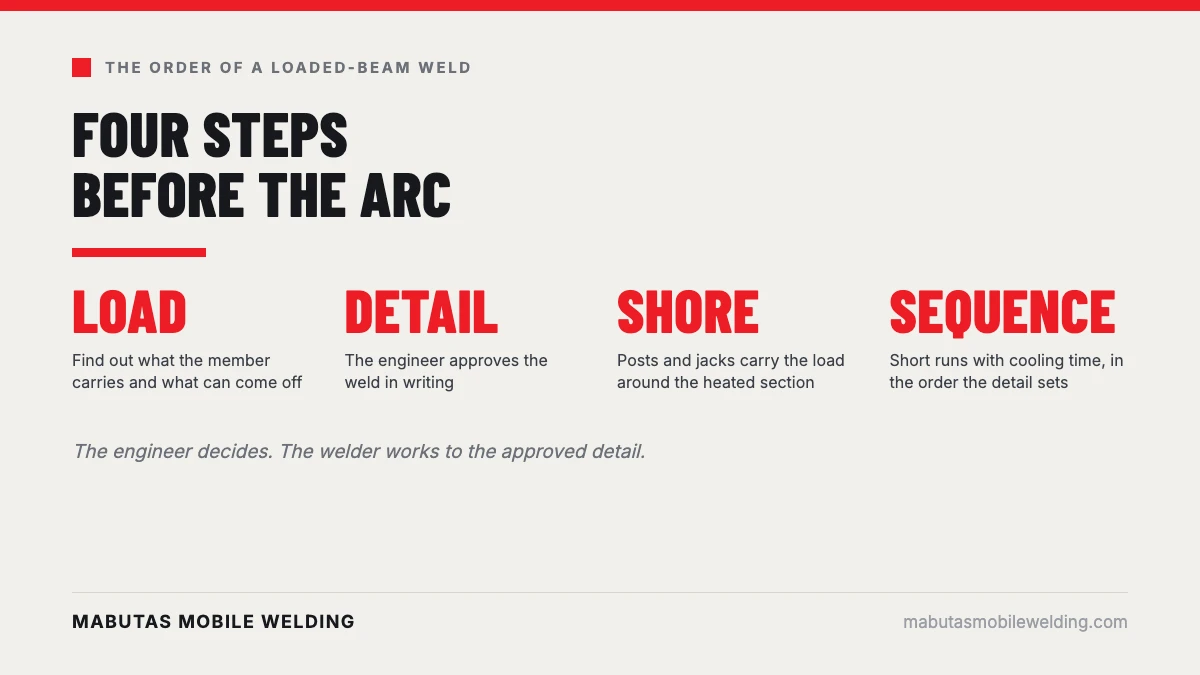
On any member that carries a floor, a roof or a mezzanine, the engineer decides, and the welder carries out the approved detail. That is the principle in the steel structures code too: AWS D1.1 has a section on strengthening and repairing existing structures, and it treats that work as engineered work, not as a call for the person holding the electrode. A welder does not design the shoring, stamp a drawing or decide that a beam is safe to heat.
Find out first whether the building has drawings and an engineer of record. For a small bracket on a secondary member, the engineer may say in two lines that it is fine as detailed. For a plate on a main beam, expect a sketch with the weld lengths, the sequence and the load conditions written on it. If the building has no drawings, a structural engineer can assess the member on site. Get the answer in writing before a date is set.
A short package saves a round of back and forth. Photograph the member from both sides and the underside, with a tape or a marker in the frame. Note what sits on it or hangs from it, and what is on the floor or roof it supports. Write down the weld you think you need: a plate, a bracket, a repair to a cracked flange. Find any drawings, even old ones, and the name of whoever last had an engineer look at the building.
That package lets the engineer say yes, no or "show me more" quickly, and it lets the welder tell you what the access looks like. It also makes the schedule honest, because the engineer can see the load and the space before anyone picks a date.
There are two ways to reduce what the member carries. The first is to remove it: clear the stored product from a mezzanine bay, move a rooftop unit, empty a hopper. The second is to carry it another way while the weld is made: posts and jacks under the member, or a temporary beam beside it, set so the load travels around the section being heated.
Shoring is designed. Where the posts bear, how much each carries and when they come out are decisions for the engineer, and they depend on the floor below being able to take the temporary load too. For you, the useful work is the list: what can be moved off the area, how long a bay can sit empty, and who controls the space below. A warehouse manager who can clear a bay on a Saturday has made the job easier before anyone has picked up a torch.
Heat input is the thing to control. On a loaded member the weld is made in short runs with time to cool between them, in an order that spreads the heat along the plate and does not pile it into one spot. A reinforcing plate is often welded in a balanced pattern, working from the middle outward, so the steel is never hot in one place for long.
The actual weld lengths, sizes and order come from the approved detail. That is the line between principle and procedure, and it is why a welder should be asked, before the job, how heat input will be controlled and where the sequence is written down. A welder should be able to tell you where the sequence is written down.
A bracket on a secondary member with the engineer's okay can be a short visit. A plate on a primary member with shoring is a planned job: engineer review, clearing the area, setting the shoring, welding, letting the member cool, and removing the shoring in the reverse order. Plan for the review and the setup to take longer than the weld.
If the building is occupied, a permit layer applies on top of this, with its own sign-offs; the order of steps is in what hot work in an occupied building requires. Ask for a realistic lead time when you book, and treat any promise of a same-week date on a loaded primary member with care until the engineer has weighed in.
Sometimes the better reinforcement for a loaded member is a bolted or clamped one. It adds no heat to the working steel and can go on with less shoring. It has its own limits: it needs clean access, holes or clamping surfaces, and a connection designed to carry the load. The comparison, and the cases where welding to existing steel makes sense, are laid out in welding versus bolting a structural connection. How much the finished repair then holds is a separate question, covered in how strong a welded repair is under steady and repeated load.
Picture a few setups. An Addison plant mezzanine where racking has been added over the years and a beam needs a stiffening plate. A Villa Park warehouse where a rooftop unit sits on a frame that needs a repair. A Wood Dale distribution building where a column bracket has to be added to a beam that carries the floor above. In each, the first question is the same: what is the member holding up today, and who has the drawings?
For on-site structural steel welding for DuPage County builders on existing members, the scope is set on the call with the engineer's detail in hand. For commercial buildings with tenants and shared systems, on-site commercial welding in DuPage County covers how the work is scheduled around the people in the building. Welding to steel under load is routine field work when the load is understood and the detail is approved.
The same engineer question comes up when a hole has to be cut rather than a plate welded on, as in cutting holes in an existing steel beam.
Send the beam details and get a quote
Sources: American Welding Society, AWS D1.1/D1.1M Structural Welding Code, Steel