
A stainless top on a mild steel frame. A stainless bracket on a painted steel post. A stainless guard on a carbon steel machine base. The job looks simple, and welding stainless to mild steel is routine fabrication work. The weld itself is rarely what fails. What fails is the wrong filler, too much mixing in the weld pool, or corrosion that starts on the mild steel side once the joint lives outside and gets wet. Here is how each of those gets handled, in the order they tend to go wrong.
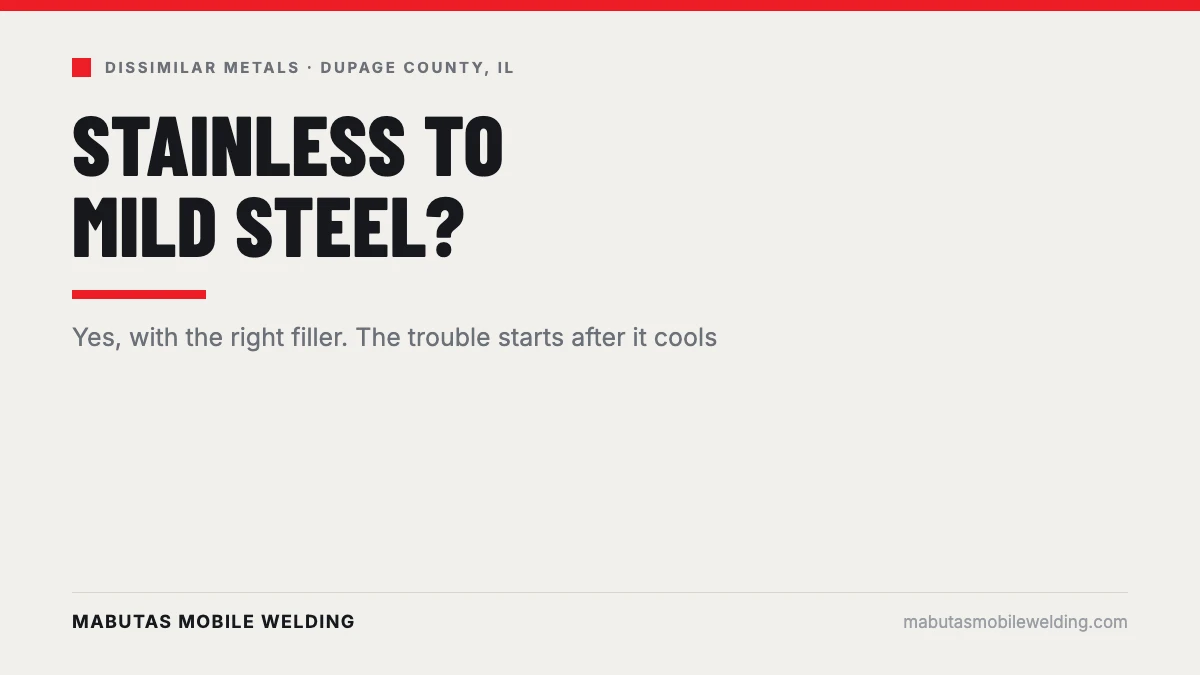
Yes. It is done every day with an over-alloyed filler that stays tough after the mild steel mixes into it. The weld is the easy half. Protecting the joint afterward is the half that decides how long it lasts.
Stainless and mild steel fuse together without trouble. The problem is what the weld metal turns into. The pool pulls metal from both sides, so the deposit ends up as a blend of the filler and the two base metals. If that blend lands too low in chromium and nickel, it solidifies as martensite, a hard, brittle structure that tends to crack as it shrinks. The Australian Stainless Steel Development Association puts it plainly in its guidance on welding dissimilar metals: carbon steel must not be welded directly to austenitic stainless.
The fix is a filler with more alloy than either base metal needs. 309L carries enough extra chromium and nickel that, after the mild steel dilutes it, the weld still comes out austenitic with a little ferrite to resist shrinkage cracks. For 316 stainless the matching choice is 309LMo, which adds molybdenum. A 308 filler, the usual pick for joining 304 to 304, does not carry that margin, and diluted with mild steel it can drop into the crack-prone range.
Filler choice assumes a normal amount of mixing. Push the dilution too high and even 309L can run out of margin. Look at your own joint against this list.
If two or more of those are working against you, fix the setup before you blame the filler.
| Joint | Filler usually used | Why it works | Get it wrong and | Where it fits |
|---|---|---|---|---|
| 304 stainless to mild steel | 309L | Extra chromium and nickel survive dilution from the mild steel | 308 or steel wire can leave a brittle, crack-prone deposit | Brackets, frames and guards in dry or coated service |
| 316 stainless to mild steel | 309LMo | Same margin, plus molybdenum toward the 316 side | Plain 309L gives up some of the 316's pitting resistance at the joint | Wash-down or salt exposure, still coated on the steel side |
| 304 stainless to 304 stainless | 308L | Matches the base metal with no mild steel in the blend | 309 here costs more for no gain | All-stainless assemblies |
| Mild steel to mild steel, stainless wire still in the machine | Swap to a mild steel filler | Stainless wire will join mild steel but adds nothing | Mixed spools are how wrong-filler joints happen | Shops running both metals on one machine |
| Hot service, such as exhaust or oven parts | Nickel-alloy filler, specified by an engineer | Limits carbon migration across the joint at temperature | A 309 joint in hot, cycling service can crack over time | High-temperature equipment only |
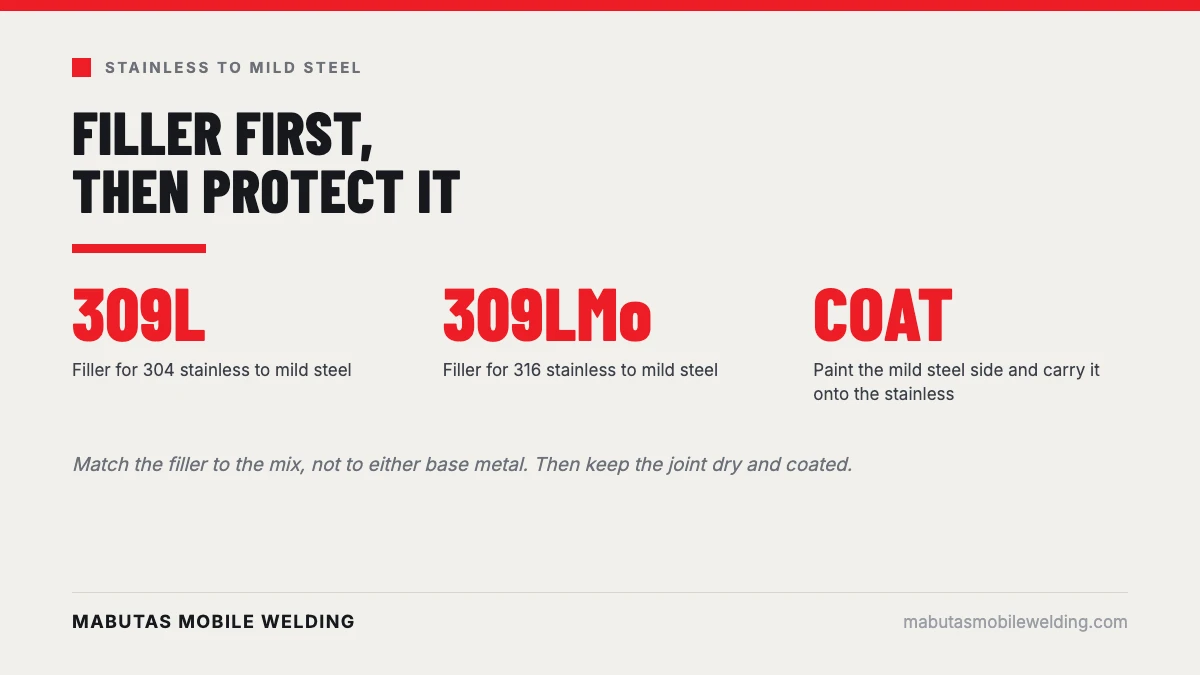
Put two different metals in contact, add water, and you have a battery. Stainless is the more noble of the two, so the mild steel becomes the anode and corrodes faster than it would on its own. The weld joins them permanently, so there is no separating them later.
Area ratio decides how bad it gets. The International Molybdenum Association's guidance on avoiding galvanic corrosion is clear that a large cathode against a small anode drives the stronger current. For this joint that means a small mild steel tab welded to a big stainless panel is the bad case. A small stainless bracket on a large, painted steel frame is far more forgiving.
What to do about it:
Outdoors and unprotected, this joint has a shelf life. Coated and draining, it can last as long as the rest of the assembly.
The straw, blue and purple colors beside a stainless weld are not cosmetic. They mark an oxide layer that is poorer in chromium than the passive film stainless relies on, and that band will rust first. ASSDA's guidance is to clean slag and heat tint off the weld area so the weld can be inspected and painted.
Stainless can also sensitize when the heat-affected zone spends too long in roughly the 800 to 1,600°F range: chromium combines with carbon at the grain boundaries and leaves the metal beside them open to attack. The low-carbon L grades and L fillers exist to limit that, and keeping heat input down helps as well.
Two cleanup rules decide whether the stainless side stays clean. Use stainless-only grinding wheels and wire brushes, because tooling that has touched carbon steel leaves iron in the surface that turns into rust spots. And plan the finish. On all-stainless work the last step is often chemical cleaning and passivation to standards such as ASTM A380 and ASTM A967. ASSDA notes that acid pickling is not possible on a part that mixes stainless and carbon steel because the acid attacks the carbon steel, so on this joint mechanical cleaning and a good coating system do that job instead.
The typical cases: stainless tops, shelves and sinks sitting on mild steel frames in food-service and processing spaces, brackets that tie new stainless equipment into an existing steel structure, stainless guards and brackets on painted machine bases, a stainless rail or post tied into an existing steel stanchion at a commercial entry, and stainless hardware on trailer and equipment frames. If that entry rail also has to meet code, the dimensions are covered in Illinois stair and railing code.
Across the county, the environment is what changes the answer. A joint inside a dry warehouse in Lombard or Glendale Heights is forgiving. The same joint at a building entry in Oak Brook or Naperville takes deicing salt every winter, and one in a wash-down room in Villa Park gets wet every day. Tell whoever quotes it where the part will live, because that decides the coating, not just the filler.
According to OSHA's hexavalent chromium guidance, hot work such as welding on stainless steel is a major source of worker exposure to hexavalent chromium, which has its own OSHA standard and exposure limit. That is a different hazard from the zinc fume covered in welding galvanized steel. In practice it means local exhaust or strong ventilation at the arc, keeping your head out of the plume, and respiratory protection where ventilation cannot keep up. A welding helmet protects your eyes and face. It is not a respirator.
If the part is structural, going outdoors or going into a wet space, it is worth having it built by someone who plans the filler, the joint and the coating together. Custom steel fabrication for DuPage County shops and contractors covers brackets, frames and mixed-metal assemblies, and one-off decorative pieces in stainless and steel fall under custom and decorative welding.
Sometimes the right answer is not a weld at all. When keeping the two metals apart matters more than stiffness, a bolted connection with isolating washers does it. If you are choosing which process to run on stainless, the trade-offs are in TIG vs MIG vs stick, and cast iron has its own rules, covered in can you weld cast iron.
If you are weighing a bolted connection against a weld on structural steel, welding vs bolting on a structural connection covers how that call gets made.
Send a photo of the parts and get a quote
Sources: ASSDA, Technical FAQ 9: Welding Dissimilar Metals · International Molybdenum Association, Avoiding Galvanic Corrosion · ASTM A380, Cleaning, Descaling, and Passivation of Stainless Steel · ASTM A967, Chemical Passivation Treatments for Stainless Steel Parts · OSHA, Hexavalent Chromium