
Most people calling a mobile welder do not care which process gets used. They care that the crack stops coming back, the gate stops sagging, and nobody has to shut the site down twice. But the process does decide what is possible on site, how long it takes, and what it costs, so it is worth ten minutes of your time before you book anyone. Here is how TIG welding services, MIG, and stick actually differ once the truck is parked in your lot.
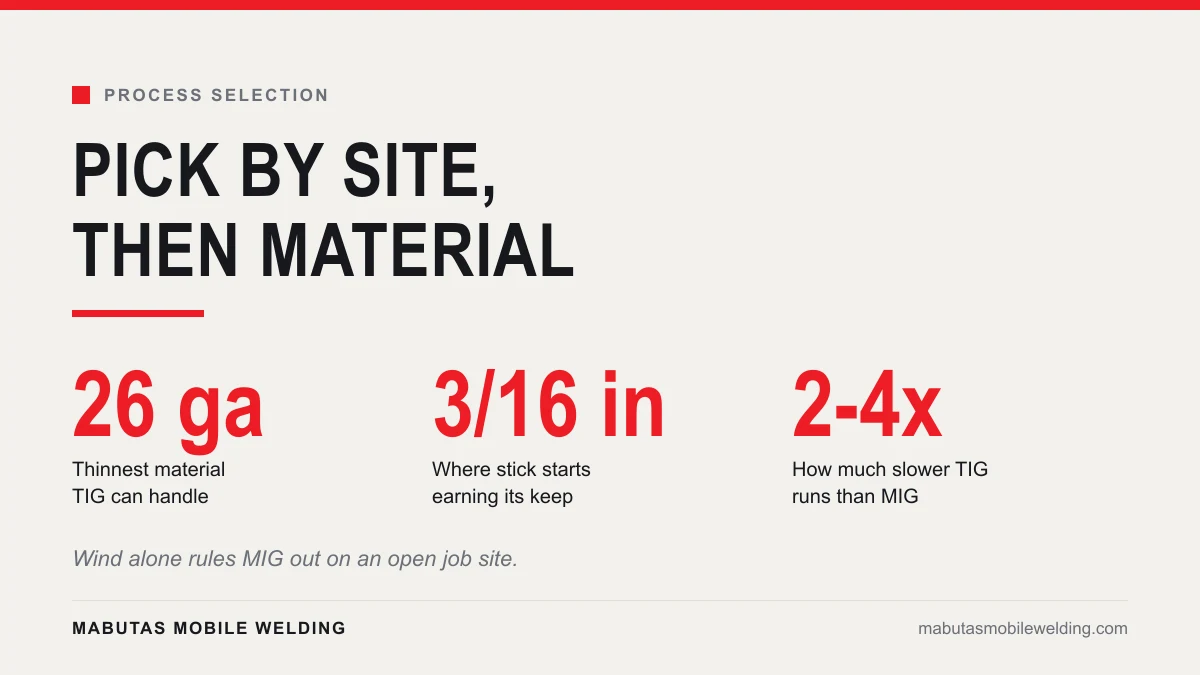
This is the part that surprises people. The material matters, but the location often decides first. MIG uses shielding gas blown over the weld puddle. A breeze around ten to fifteen miles per hour is enough to strip that shield away and leave porosity, which is a weld full of tiny gas pockets that fails early. Out in a parking lot, a loading dock, or a field, that rules MIG out unless the welder can screen the area off.
Stick does not have that problem. The flux coating on the rod creates its own shielding as it burns, so it works in wind, in rain, and over surfaces that are not perfectly clean. That is exactly why it is the default for structural repairs on real job sites.
TIG needs the calmest conditions of the three, plus a steady hand and time. Nobody TIG welds a fence post in a windstorm. When TIG is the right call on a mobile job, the welder either brings a screen or moves the piece somewhere protected.
Once location is handled, material decides the rest.
| Process | Best for | Thickness | Speed | Appearance | Works outdoors |
|---|---|---|---|---|---|
| Stick (SMAW) | Structural steel, repairs on dirty or painted metal, heavy equipment | 3/16 in and up | Moderate | Rough, needs cleanup | Yes, including wind and damp |
| MIG (GMAW) | Clean mild steel, long seams, fabrication runs, gates and frames | 24 gauge to 1/2 in | Fastest | Good | Only if shielded from wind |
| TIG (GTAW) | Aluminum, stainless, thin wall tube, visible architectural work | Down to 26 gauge | Slowest | Cleanest | Only in calm or screened conditions |
The thickness column is where most bad jobs start. Running stick on thin sheet burns straight through it. Running MIG on heavy structural steel without proper preparation gives you a weld that looks fine and has almost no penetration, which is worse than an ugly weld because you cannot see the problem.
Some materials remove the choice entirely.
When you call for a quote, ask what the metal is and whether it can be welded where it sits. If a welder commits to a process before knowing the alloy and seeing the location, that is a reason to keep calling.
Process choice shows up on your invoice as labor hours, not as a line item.
TIG runs roughly two to four times slower than MIG on the same joint. That is not inefficiency, it is the nature of the process, one hand feeding filler and one on the torch. If a job can be done well with MIG and you insist on TIG for looks, you are paying for the appearance. Sometimes that is exactly right, like a handrail in a front entry. On a trailer frame under a deck, it is money burned.
Stick sits in between on speed, but adds cleanup. Slag has to be chipped and the weld usually needs grinding if it will be seen or painted.
Plenty of real jobs use two. A cracked equipment bucket might get stick for the structural repair where strength matters and nobody sees it, then a MIG pass on a cosmetic edge. A stainless rail with a steel base plate uses TIG on the stainless and MIG or stick on the base. A welder who only offers one process will fit your job to their equipment instead of the other way around.
A mobile setup is not a shop on wheels, and knowing the limits saves you a wasted appointment.
Power is the first limit. An engine driven welder on the truck supplies its own current, which is why stick and flux core work anywhere. TIG on aluminum needs AC output and high frequency start, and not every mobile rig carries that. If your job is aluminum, ask specifically whether the truck runs AC TIG before anyone drives out.
Position is the second. Welding overhead or flat on your back under a trailer is slower and harder than working on a bench, and it changes what process is realistic. Overhead TIG is possible and expensive. Overhead stick is routine.
Size is the third, and it usually works in your favor. Anything too big or too awkward to move is exactly what mobile welding exists for: gates still hung on their posts, railings bolted to concrete, equipment sitting where it broke down, structural steel already in place. If a piece can be carried to a shop easily, a shop may be cheaper. If it cannot, mobile is not a premium, it is the only sensible option.
Fire and access are the last two. Welding near dry grass, fuel, finished flooring, or a sprinkler head needs shielding and sometimes a fire watch. And the truck has to physically reach the work, generally within the length of the leads, which is usually somewhere around fifty to a hundred feet.
Most second visits are avoidable. Before the welder arrives:
Mabutas Mobile Welding runs all three processes from the truck, across Villa Park, Elmhurst, Lombard, Addison, Oak Brook, Hinsdale, Naperville and Wheaton. Most repairs are done on site the same visit.
That cast iron bullet deserves more than one line, so we gave it a page: what it takes to MIG weld cast iron covers nickel filler, preheat and why the crack usually comes back beside the bead rather than in it.
Coated steel is its own conversation as well. Welding galvanized steel walks through grinding the zinc back, keeping the fume off you, and restoring the coating so the repair is not the first thing to rust.
A quick word on why this page exists. A mobile welder does not get found on Google by accident, and for a long time this business was not. The story of how the shop went from invisible to first on Google is the reason a guide on TIG, MIG and stick is sitting in front of you instead of a national ad.
Joining two different metals raises a question no process choice answers on its own. Welding stainless to mild steel covers the 309L filler, dilution and the corrosion that starts after the weld cools.
Get a quote on your welding job
Sources: American Welding Society · OSHA Welding, Cutting and Brazing · NIOSH Welding Safety