
You hooked up the trailer, glanced under it, and there it is: a crack in the frame rail, or a spring hanger hanging on by half a weld. First question everybody asks is the title of this post. The honest answer from a welder: yes, almost always, if the metal around it is still sound and the repair is done right. This post covers how to tell the difference, what a real repair looks like, and when the right call is to stop towing today.
Steel cracks do not heal and they do not stay put. Every bump and every load cycle works the crack tip and makes it longer. That is basic metal fatigue, and it is why a crack you could have fixed in an hour becomes a rail replacement by fall.
The worst case is not the repair bill. A frame that lets go at highway speed can drop the load, fold the tongue, or put the trailer sideways in traffic. And if it is a commercial trailer, a cracked frame is a violation before it is a breakdown: federal rules say the frame of a commercial vehicle "shall not be cracked, loose, sagging or broken" (49 CFR 393.201). An inspector who finds it can put the trailer out of service on the spot, and now the crack costs you jobs, not just steel.
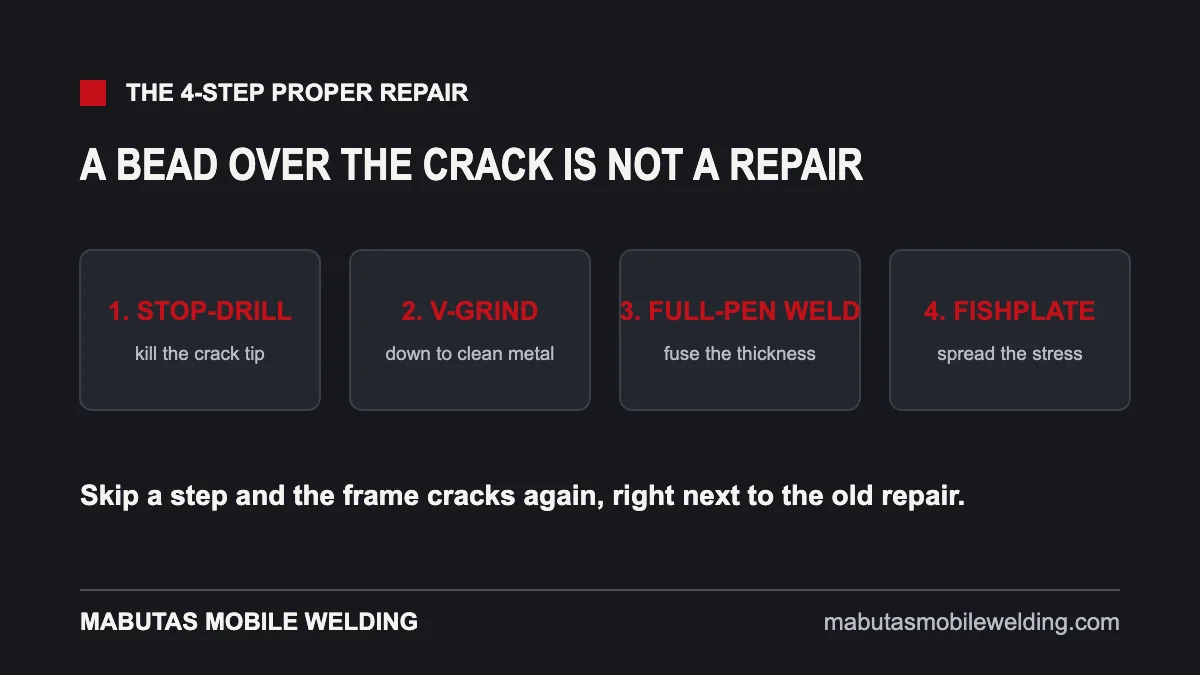
Here is the difference between a repair and a re-crack waiting to happen. A correct fix on a steel frame follows the same logic certified structural work does under codes like AWS D1.1, the structural welding code for steel:
Skip any of those steps and the frame usually cracks again right next to the old repair, because the stress moved next door.
| What you're looking at | Weld it | Replace the section (or the trailer) |
|---|---|---|
| Single clean crack, solid metal around it | Yes. Standard repair, done in a visit. | Not needed. |
| Crack at a spring hanger or crossmember joint | Yes, with grinding, full-penetration weld, and reinforcement. | Only if the hanger area is rusted thin. |
| Rail rusted thin or oil-soaked around the crack | No. Weld won't hold in bad base metal. | Cut out and replace the section with new steel. |
| Same spot cracked two or more times before | No more bead-stacking. | Section replacement plus reinforcement, or retire it. |
| Multiple cracks all over the frame | Rarely worth it. | The frame is telling you it's done. Replace. |
| Aluminum frame, cracked near a weld | Sometimes. Heat weakens aluminum around the weld, so it needs an experienced hand and usually plating. | Often the smarter call on structural aluminum members. |
Don's take: "I'll tell you straight either way. If your frame is worth fixing, I'll fix it so it doesn't come back. If it's rusted through and welding it would just be taking your money, I'll show you why and you can make the call. I'd rather lose an hour than have my name on a repair I don't trust behind someone's truck."
The standard advice online is "take it to a welding shop." Think about what that means: hitching a compromised frame to your truck and dragging it down Route 83. If the crack is anywhere near the tongue or the hangers, the smart move is the opposite. Have the welder come to the trailer. On-site repair in your driveway, yard, or job site means the frame gets fixed before it gets towed, not after it survives one more trip.
That is the core of our mobile trailer repair and welding service: the rig comes to you, the crack gets ground out and welded where the trailer sits, and you hook up to a frame you can trust. The same on-site setup handles heavier structural work too, from beams and supports to heavy equipment repair in the field.
In most cases yes, and welded so it is as strong as it ever was. The exceptions are frames that are rusted thin, cracked all over, or repaired badly too many times. The one wrong answer is doing nothing, because cracks only grow, and on a commercial trailer they are a violation sitting under your load. Get eyes on it early and the fix is small.
One more thing to look at before the grinder comes out: plenty of utility and equipment trailers are galvanized, and burning straight through zinc puts fume in your face and porosity in the bead. Welding galvanized trailer steel starts by taking the coating back and finishes by putting it on again.
Whether the crack can be welded is one question. What the repaired frame will hold on the highway is another, and how much weight a welded repair holds covers static strength, fatigue life and the check to do before loading it.
A cracked frame is one of the repairs that can usually be made in the yard, and field welding vs shop welding lists the conditions that would send it to a shop instead.
A trailer sitting in a Bensenville yard or an Elmhurst driveway is repaired where it stands, as trailer welding repair in Bensenville and trailer welding repair in Elmhurst describe.
Text a photo or call 312-324-4832. Straight answer on whether it's weldable, a real quote, and we come to the trailer anywhere in DuPage County and the western suburbs.
Get a Fast QuoteSources: 49 CFR 393.201, Frames (eCFR) · AWS D1.1/D1.1M Structural Welding Code (American Welding Society)
Trailer frame work is a frequent call in Wood Dale.