
A truck backed into it, a forklift clipped it or a snowplow caught it, and now the bollard leans, bends or has snapped at the base. Search damaged steel bollard repair or replace and the sellers tell you to replace it while the striping companies offer to reinstall one. The middle option, a welded repair on site, gets almost no explanation. This post covers how to tell which of the three applies before anyone breaks concrete.
Most bollard decisions turn on the foundation, not the pipe. If the footing or base plate is sound, the steel above it can often be straightened or cut off and replaced with a new welded section. If the footing has cracked or moved, or the bollard is a crash-rated product, replacement is the honest answer.
The repair depends on how the bollard is held in the ground, so start there. A pipe bollard filled with concrete and set in a footing is one common build, and the one this guide covers. A surface-mounted bollard sits on a steel base plate bolted to a slab with anchors. A sleeve-set or removable bollard drops into a socket cast into the ground.
Three photos tell most of the story: one of the whole bollard from a few feet back, one of the base where it meets the ground, and one of the damaged area close up with a tape or a hand in the frame. Take them before you call anyone, and note whether there is a manufacturer's plate or marking on it. That marking matters in the last section.
A bent pipe is easy to see, so it gets the attention. The footing is what holds the bollard against the next hit, and it takes damage that does not show from the front. Walk around the base and check five things before you decide.
| What you see | What it usually means | Likely option |
|---|---|---|
| Slight lean, concrete at the base looks intact | The pipe likely took the hit, but check the footing before you trust it | Straighten or cut and re-weld |
| Pipe bent or creased above grade, footing sound | Damage is in the steel above the ground | Cut off above sound steel and weld a new section |
| Cracks or a raised edge in the concrete around the base | The footing moved when it was hit | Footing repair or replacement first |
| Bollard rocks or shifts when pushed | The embedment or the anchors have let go | Replacement or a new footing |
| Surface-mounted: torn base plate or pulled anchors | The plate and anchors took the load | New plate and anchors, or replacement |
A bollard that leans is no longer doing its job. It protects a dock door, a gas meter, a storefront corner or a rack end, and a bent one will give way sooner on the next hit. A bollard that is cracked at the base can also fall over, onto a vehicle or a person. Fix it, or at least cone it off and take photos of it, as soon as the lot is safe to work in.
Photos taken on the day also help with the property manager, the tenant who owns the vehicle or an insurer, whichever applies. Show the damage, the base and the surroundings. Whoever pays for the repair, the decision of what to do with the steel is the same one this post walks through.
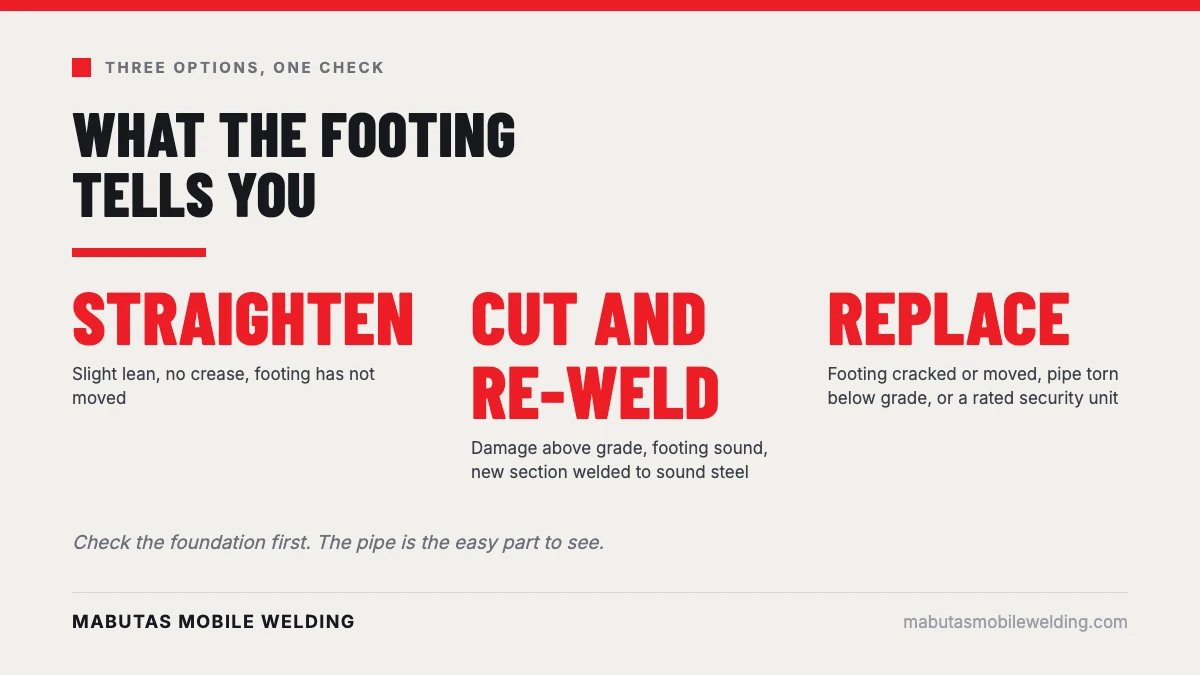
A slight lean or a shallow dent in an otherwise sound bollard can be straightened and repainted. It works best on a pipe with no crease and a footing that has not moved. It is the right call when the damage is cosmetic and the bollard still stands the way it did.
It has limits. A pipe that has been creased or kinked has been worked past what straightening can undo, and forcing it back can leave a weak point that looks fine. Straightening also hides damage if the footing moved, so do the foundation check first. If the lean returns, or paint cracks along the bend, the repair was covering a problem.
This is the middle option the replacement sellers skip. The damaged pipe is cut off above sound steel, a new section of pipe is welded to the stub or to the base, and the bollard is refilled and recoated. On a surface-mounted bollard, a new base plate can be welded on and the anchors replaced or re-set.
The work is done where the bollard stands, which is why it suits yards, docks and lots where a lane cannot stay closed for long. On a bollard filled with concrete, the fill near the cut is usually cleared back so the weld is made on bare steel. A galvanized bollard adds zinc to deal with, covered in can you weld galvanized steel.
When you ask for a quote, ask four things. Where will the cut be made, and why there? What is the new section made of, and how is it joined to the old? How will the weld be protected from rust? Who handles the footing if it turns out to need work? The new sections, base plates and sleeves are made parts, and steel fabrication for DuPage County projects covers that side. How much a finished weld holds is covered in how strong a welded repair is.
Surface-mounted and embedded bollards get repaired differently, so it helps to know the difference when you call. With a surface-mounted bollard, the base plate and anchors are the weak link, and the repair often involves new anchors set into sound concrete beside the old ones. With an embedded bollard, the steel below grade is hard to inspect, so the repair usually starts from the sound stub above the concrete. Where a sleeve is cast into the ground, the sleeve is checked first, and a damaged one changes the whole job.
In every case, the work follows the same order: look at the footing, decide where sound steel begins, cut back to it, weld on the new part, then fill and coat. Taking a shortcut on the first step is how a welded repair gets knocked over a second time.
Replacement is the honest answer in a few cases. The footing has cracked, heaved or moved. The pipe is torn below grade, where a welded section cannot reach sound steel. The bollard has been hit repeatedly and the damage keeps coming back. Or the bollard is a rated security product.
That last case is a different decision. A crash-rated bollard is tested and sold as a complete unit, with its foundation, as a manufacturer matter. A field weld cannot restore that rating, and nobody should claim it does. If a bollard has a manufacturer's plate or came with paperwork about its rating, call the manufacturer first, and treat any damage as a replacement question for them to answer.
If the footing needs to come out and be poured again, that is concrete work, and it may need a concrete contractor alongside the welder. Say so up front so the lot is not closed twice.
Cost drivers are worth understanding before you compare quotes. The size of the pipe, the number of bollards, whether the footing needs work, whether the new section has to be made first, and how hard the access is all change the price. Our guide to what drives mobile welding cost in DuPage County covers how to read a quote.
A bollard that keeps getting hit is telling you something about the lot. Walk it once and note which bollards take repeat damage. Look at the turn radius at that corner, the sightline from the driver's seat, the height of the bollard against the vehicles that use the area, and whether the color stands out in low light or snow. Reflective wraps, a better location or a sleeve that makes the next replacement a quick swap can all cost less than the third repair.
Think of a Bensenville loading dock where a truck swings wide, a Carol Stream distribution yard with forklift traffic, or a Wood Dale retail lot with a snowplow route along the curb.
For properties with docks, yards and lots, on-site commercial welding in DuPage County is scoped on the call, once the type, the foundation and the damage are known. Bollard repairs and replacement sections are routine on-site work in DuPage yards and lots.
Send photos of the bollard and get a quote
Sources: Federal Highway Administration, Primer on Impact Protection for Critical Transportation Infrastructure; University of Michigan, Standard Detail: Bollard
If the repair means cutting into the structure itself, the rules change. Read what a trade can cut in an existing steel beam before anyone marks the steel.