
A stock lift needs a bracket welded back on inside a store that opens at six. A mezzanine rail needs a post re-welded in a warehouse running two shifts. A canopy column needs a plate added over a doorway tenants use all day. Search hot work permit welding occupied building and most of what comes back is written for the safety officer who runs the program. This is written for the person arranging the job: what happens, in what order, and who owns each step.
Hot work is any job that makes sparks, open flame or enough heat to start a fire: welding, cutting, grinding, brazing. In a building with people in it, the work runs under a written permit that the building side issues, inside a cleared radius, with a fire watch that outlasts the arc and the alarm and sprinkler systems handled on purpose rather than by accident.
Welding, torch cutting, grinding, brazing and anything else that throws sparks or carries open flame. Most people picture the arc and forget the grinder, and the grinder throws sparks further.
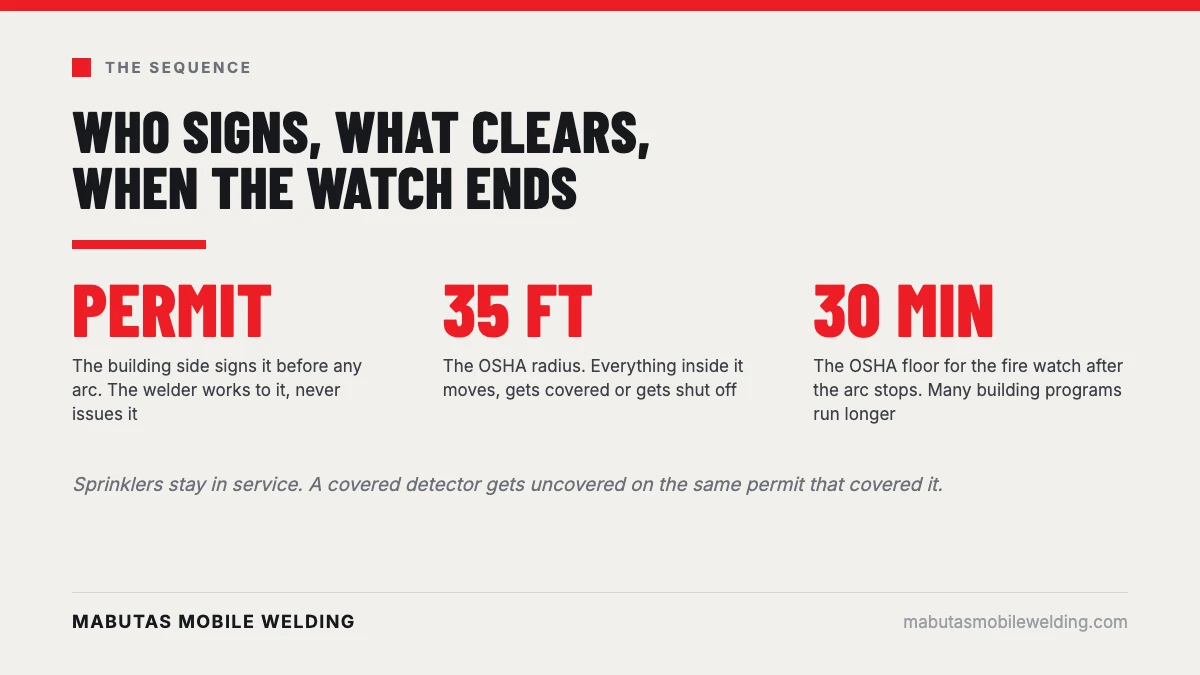
The number that organizes the whole job is 35 feet. OSHA 1910.252 calls for fire watchers wherever appreciable combustible material sits closer than 35 feet to the point of operation, where combustibles further away are easily ignited by sparks, or where wall or floor openings within a 35-foot radius expose combustibles in another area. The same rule says combustibles get moved at least 35 feet from the work or protected with flameproof covers or metal shields.
Your first job is a walk. Pace 35 feet from the weld in every direction, including up, down through the floor, and through the wall to whatever is on the other side. Write down everything inside that circle. That list becomes most of the permit.
OSHA puts it plainly. Before cutting or welding is permitted, the area is inspected by the individual responsible for authorizing cutting and welding operations, who designates the precautions to follow, preferably in the form of a written permit. That individual is on the building side. The property owner, the host employer, or the facilities or property manager acting for them.
If you are a tenant, your lease usually puts the landlord or the property manager in the chain, and many managed buildings have their own permit form. If you own the building and run the business in it, you are the authorizing individual whether you have a form or not. The welder works to the permit. A welder who brings his own permit is handing you a piece of paper nobody in your building has read.
Find out today which of the three it is. That answer decides who you call first, and it is usually the slowest part of the job.
A permit is a checklist with a signature on it.
| Line on the permit | Why it is there | Who owns it |
|---|---|---|
| Exact location and what is being done | So the person signing has stood where the sparks will land | Building side, with the welder |
| Process and equipment | Arc, torch and grinder throw sparks differently; fume differs too | Welder |
| Date and time window, including the watch period | The permit expires. A new day or a new location is a new permit | Building side |
| Combustibles moved or covered within 35 feet | The OSHA radius, checked and initialed | Building side |
| Floor openings, wall gaps, ducts and conveyors handled | Sparks travel. The far side of a wall gets the same care as the near side | Building side |
| Sprinklers confirmed in service | OSHA prohibits the work while sprinkler protection is impaired | Building side |
| Detectors covered or zone on test, and the re-enable step | Stops a nuisance evacuation, and stops the building sitting blind afterward | Building side, with the alarm company |
| Extinguisher at the work and a trained fire watcher named | The watch has to be a person with equipment, not a hope | Both sides, settled in the quote |
| Close-out signature after the watch ends | The record an insurer asks for | Building side |
Hand that table to whoever signs. If the building has no form, the table is the form.
A fire watch is a named person whose only job is to watch for fire. OSHA requires fire watchers to have extinguishing equipment ready and be trained in using it, to know how to sound the alarm, to watch all exposed areas including the far side of walls and the floor below, and to fight a fire only when it is clearly within the capacity of the equipment at hand.
The step people forget is the continuation. OSHA says the watch is maintained for at least a half hour after welding or cutting is finished, to catch smoldering fires. NFPA 51B, the fire-prevention standard for hot work that many insurers and municipalities adopt, sets its own watch and monitoring periods, and they run longer than OSHA's floor. Find out which one your building or your insurer follows before the day, not after.
The welder cannot be the fire watch. A person with a hood down is not watching the floor below. Staff the watch before the welder arrives, from your own people or the building's.
Two systems, two different rules. Sprinklers stay in service. OSHA lists cutting or welding in a sprinklered building while that protection is impaired among the prohibited situations, so nobody closes a sprinkler valve to make the day easier.
Smoke detectors are different. Welding fume and grinding dust will trip a detector near the work, and in an occupied store or office a nuisance trip means an evacuation. The usual practice is to have the alarm company put the zone on test for the window, or to cover the detectors nearest the work. Both carry a second step: the zone comes off test and the covers come off before anyone leaves. Write the re-enable step on the same permit that authorized the isolation, with a name beside it. That is how a building avoids sitting unprotected overnight because a cover was forgotten.
Inside the radius, OSHA's list is specific. Combustibles relocated or protected. Floor openings and cracks guarded so sparks cannot drop to the floor below. Open doorways and broken windows treated the same way. Ducts and conveyor systems that could carry sparks to distant combustibles protected or shut down. And where welding is done on a wall, floor or ceiling, the construction rule at 1926.352 says the same precautions apply on the opposite side, because heat conducts straight through steel and sparks fall straight through gaps.
By building type: a retail unit means product on shelves, cardboard, shrink wrap and display fixtures. A warehouse means stretch-wrapped pallets, racking with cardboard in it, forklift charging stations, and hydraulic oil on the floor. An office means carpet, ceiling tiles, and the cable trays and insulation above the ceiling that nobody has looked at in years. Check the far side of every surface being welded.
The welding is often the short part of the day. The long part is the chain in front of it: the permit signature, the alarm company booking, the fire watch roster, dock hours, the freight elevator, badge access, and the occupancy window. Many occupied buildings want hot work before opening, after closing or on a weekend, so the welder's schedule, the alarm company's schedule and your staff's schedule have to land on the same hours.
Ventilation belongs here too. OSHA 1910.252 carries its own ventilation requirements, and in a closed space with people nearby fume has to be moved out, which can mean an exhaust fan, an open dock door, or a process choice. Book the alarm company and the fire watch before you book the welder. A permit signed in a hurry on the morning of the job is how lines get skipped.
The welder's rig brings its own power and the welding process. The building supplies the permit, the alarm handling, the access, the cleared radius, and ventilation if the space is enclosed. Screens, fire blankets, the extinguisher and the fire watcher can sit on either list, so name who brings each one in the quote, not on the morning. The quickest way to lose a day is two people each assuming the other brought the fire watch.
Sometimes the honest answer is to avoid the arc. A bolted splice, a clamped repair or a mechanical fastener can skip the permit chain entirely, and in a running building that is worth a lot. The trade-off is real: bolted connections behave differently under repeated load and in old steel, and some repairs cannot be made that way at all. Welded versus bolted connections under load walks the method comparison. This post does not. If a weld is the right repair, the permit is the price of it.
The completed permit, with the close-out signature and the time the watch ended, is a document. So is the fire watcher's name. If anything smolders that night, or if your insurer asks what hot work was done in the building and under what controls, that paper is the answer. File it with the work order and the welder's invoice.
The buildings in DuPage County where this applies are ordinary ones. Distribution warehouses along the Villa Park and Addison industrial corridors, with racking, dock levelers and mezzanines that take a weld while the shift runs around them. Retail units in Elmhurst and Oak Brook with stock-handling equipment and storefront steel that cannot wait for a closure. Office parks in Itasca with canopy columns, entry handrails and parking-deck steel in front of doors tenants use all day.
Each of those starts from the same four facts: what the work is, where it sits, what is within 35 feet of it, and who signs. For the commercial side that is on-site commercial welding for DuPage County businesses and property managers; where the repair is to a beam, column or support it is on-site structural steel welding and modification. Either way the permit is the building's, the fire watcher is named on it, and the welder works to both.
Searching for a hot work permit for welding in an occupied building usually means the job is already waiting. Walk the radius, find out who signs, book the alarm company and the watch, and send the photos. The welding is the easy part.
Whether a repair can be made on site at all is a separate question, covered in what can be welded in the field and what has to go to a shop.
Where the member is carrying load, welding to steel under load covers what has to happen before the arc.
Send photos of the job and get a quote
Sources: OSHA 29 CFR 1910.252, Welding, Cutting and Brazing, General Requirements · OSHA 29 CFR 1926.352, Fire Prevention (Construction) · NFPA 51B, Standard for Fire Prevention During Welding, Cutting, and Other Hot Work