
Wrought iron fences fail slowly, which is exactly why the repair-or-replace question sneaks up on people. One year it is a little surface rust, the next a picket is loose, then a gate drags, and one day a post moves when you lean on it. Here is how a welder actually makes the wrought iron fence repair vs replacement call, with the same checklist we run at the fence line.
Grab a flathead screwdriver and go down the fence. At every rusty spot, press and scrape.
One more spot the eye misses: the bases. Iron corrodes fastest where it touches soil, so check every picket bottom and post base. Ground contact anywhere it does not belong is where fences rot first.
Rust is not a stain, it is a process. Left alone, cosmetic rust becomes pitting, pitting becomes rust-through, and a $200 clean-and-weld visit becomes a multi-section rebuild. Two other costs sneak in:
| What you see | Repair | Replace | Ballpark |
|---|---|---|---|
| Surface rust, solid metal underneath | Yes: clean, treat, prime, paint | No | Low, often per-section |
| One or two broken or bent pickets | Yes: weld or fabricate matching pickets | No | Low |
| Leaning or loose post | Yes: reset or reinforce, re-weld connections | No, unless base is rusted through | Moderate |
| Sagging or dragging gate | Yes: hinge repair, re-hang, brace | Rarely | Moderate |
| Rust-through on a few sections | Yes: cut out and weld in new steel | Only those sections | Moderate, per section |
| More than ~20% of fence damaged or rusted through | Usually not worth it | Yes, full or major replacement | $1,300 to $4,200+ new |
| Historic or custom ornamental fence | Almost always: original ironwork is irreplaceable | Last resort | Varies, worth a quote |
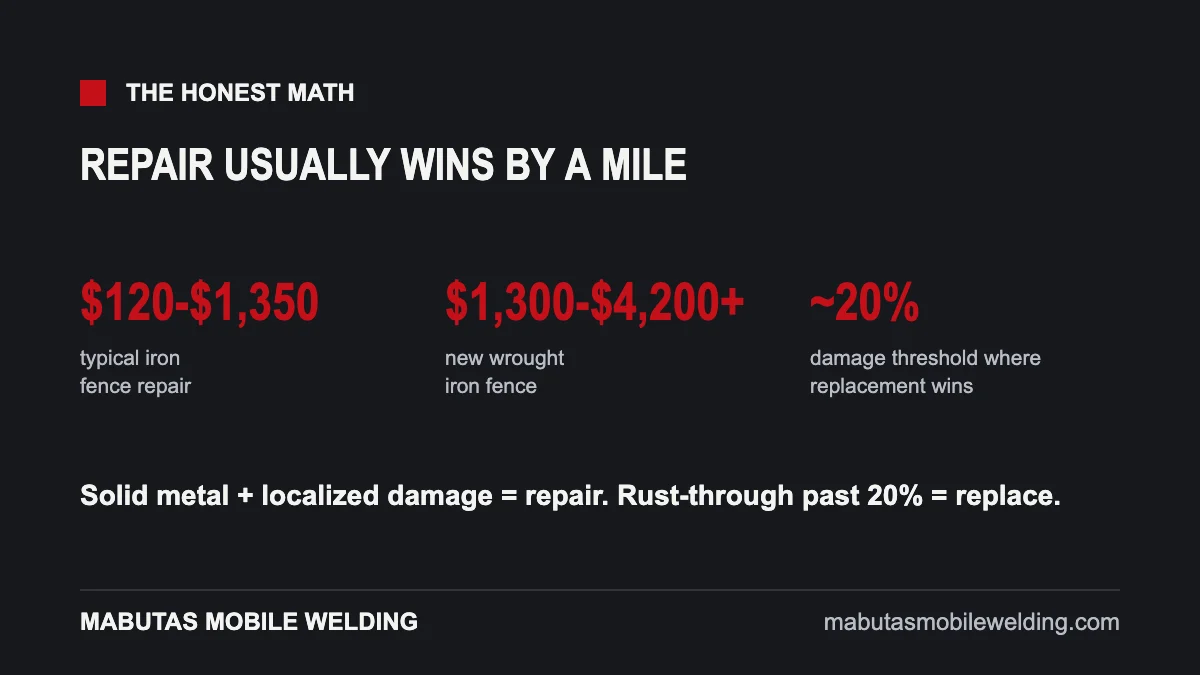
Cost figures: typical wrought iron fence repairs run $120 to $1,350, while a new wrought iron fence runs roughly $1,300 to $4,200 and can go well past that for custom work (HomeAdvisor 2026 data). That gap is why the repair-first answer is usually also the cheap answer.
Around here the fence's enemies come every winter. Freeze-thaw cycling opens hairline gaps in paint and welds, water gets in and expands, and the crack grows every cycle. Road salt spray does the rest: fences along driveways, sidewalks, and parkways rust from the bottom up faster than the same fence would twenty feet back. Two habits protect your fence: keep the bottom 12 inches painted and sealed, and rinse salt off the lower rail in spring. The National Park Service guidance is the same for any climate: keep iron out of unnecessary ground contact, stabilize rust chemically, and repaint with oil-based metal primer and paint, two coats each.
Modern replacement panels bolt together, and that is what most fence companies will sell you: pull the old section, bolt in a new prefab panel that almost matches. Real wrought iron and older steel fences do not work that way. They were welded or forged as a system, and repairing them right means cutting out failed metal, fabricating matching pieces, and welding them back in so the repair carries load like the original. That is blacksmith-adjacent work, and it is why the repair-vs-replace decision should be made by someone who can actually do both and has no reason to push you toward the expensive one.
Don's take: "Half the fences I get called to look at need a few hundred bucks of honest repair, not a new fence. If your metal is solid, I'll fix what's broken and tell you how to keep it that way. If it's rusted through and a repair would just be a bandage, I'll tell you that too, and you'll see the rusted-out metal yourself before I cut anything."
Because this is on-site work by nature, the whole job happens at your fence line. Our wrought iron fence repair service in DuPage County handles everything in the repair column above, and if the failing part is the gate itself, that is its own trade: see custom gate and driveway gate welding repair.
The decision is simpler than fence companies make it sound. Solid metal plus localized damage means repair, and repair is usually a fraction of replacement cost. Widespread rust-through or damage past roughly 20% of the fence means replacement is honest advice, not upselling. Run the screwdriver test, count the bad sections, and get a straight quote before anyone talks you into a whole new fence.
One thing worth checking before you decide: the pickets on an older fence are usually steel, but the posts, finials and column shoes often are not. If yours are castings, read how cast iron gets welded and when it should not be first.
Text photos to 312-324-4832 or request a quote online. You'll get a straight answer: what's fixable, what's not, and what it'll cost, with the welder coming to you anywhere in DuPage County.
Get a Fast QuoteSources: Iron Fence Repair (U.S. National Park Service) · Wrought Iron Fence Repair Cost (HomeAdvisor, 2026)
Before the repair-or-replace question comes up at all, it helps to know what the rust has already taken. Fixing a rusted wrought iron fence covers the screwdriver test that sorts surface rust from section loss, which is the thing that moves this decision either way.
When the damage is one post gone at the ground line rather than the whole run, the call is a method call rather than a budget one: sleeve, splice or replace a fence post rusted at the base walks through which of the three the post will still take.
Fence repairs are a regular job for us in Glendale Heights.
On larger lots the repair-or-replace maths changes again, because the run is longer and the gate is heavier. See how it plays out on Burr Ridge iron fence and gate work.