
A wrought iron fence post rusted at base level almost never gives you much warning. The metal up at eye height still looks fine, the paint is holding, and then one windy week a whole panel leans and you find the post is gone in a band an inch or two wide right where it meets soil or concrete. By then the question is not whether to fix it. It is which of three fixes the post will still take: sleeve it, splice new metal into it, or pull it out and set a new one. Here is how that call gets made, and how to make it yourself before anybody quotes you.
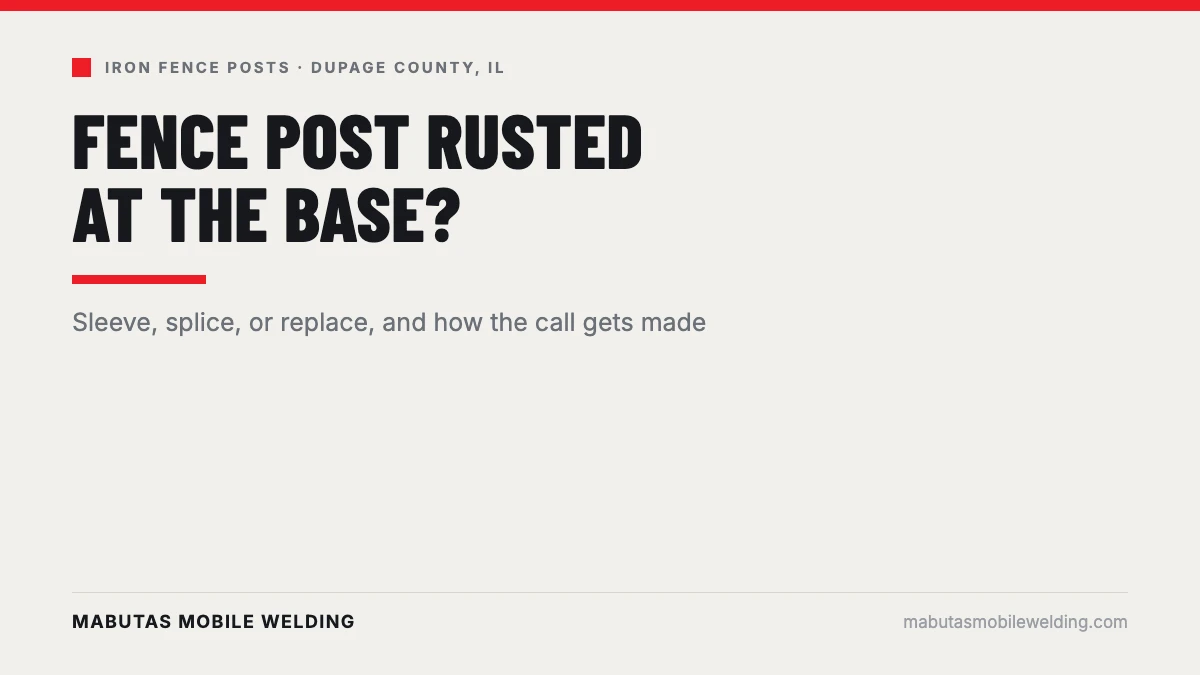
It depends on two things: how much sound metal is left above the corroded band, and whether the footing is still doing its job. Sound metal above plus a good footing means a sleeve or a splice. Neither of those, and the post comes out.
Corrosion needs water and oxygen together. Buried metal runs short on oxygen, metal up in the air runs short on standing water, and the interface between the two has plenty of both. That band where the post enters soil or concrete is the wettest few inches on the whole fence, and it stays that way for days after everything else has dried. Water wicks into the hairline gap between post and collar and cannot get back out, so freeze-thaw opens that gap wider every winter, and deicing salt off a road or sidewalk lands in the same band and moves corrosion along faster than plain water does.
The part that catches people out is direction. A hollow post fills at the top or through a joint and rusts from the inside toward the outside, so the outer face can still be painted and presentable while the wall behind it is paper. That is why the post fails with no warning, and why the only honest test involves pushing on it. Rust anywhere else on the fence is a different conversation with a different answer, and we covered it in how to fix a rusted wrought iron fence.
Take a flat-blade screwdriver and a work glove out to the fence. Five checks, in this order.
Then the thing that decides everything: how much sound metal is there above the corroded band? Tap upward from the bad zone until the ring comes back and measure that height. A few inches of good metal above the damage is enough to land a repair on. Damage that keeps going up the post as you tap is not a base problem any more, it is a post problem.
| What you find | Which fix | What it involves | What it does not fix | How long it holds |
|---|---|---|---|---|
| Surface rust at the base only, wall still full thickness | None yet | Clear the soil back, strip to sound metal, prime and coat | Nothing structural is wrong yet | Years, if the base stays clear and dry |
| Short corroded band, sound metal above and below, footing intact | Sleeve | External sleeve or internal insert bridging the band onto good metal both sides | Corrosion continuing inside the post wall | As long as the metal it lands on stays sound |
| Rust-through in a band, sound metal above, footing intact | Splice | Cut back past the damage, weld in matching stock, dress and finish the joint | A footing that is cracked or heaved | The original life of the section, if it is sealed and coated |
| Section loss running well up the post | Replace | Cut free of the rails, fabricate a post to the original profile, re-set it | Nothing, this is the full repair | The life of a new post |
| Footing cracked or heaved, post itself sound | Re-set or base plate | Re-set in new concrete, or convert to a base plate anchored to sound concrete | Corrosion elsewhere on the post | The life of the new footing |
| Panel already leaning or dropped | Depends on the post | Support the panel, fix the post to one of the rows above, bring the run back to line | Any second post that is also going | Set by the post repair, not the panel |
| It is a gate post, not a fence post | Different job | Hinge load and alignment change the fix - see diagnosing a sagging gate | Anything in the fence line | n/a |
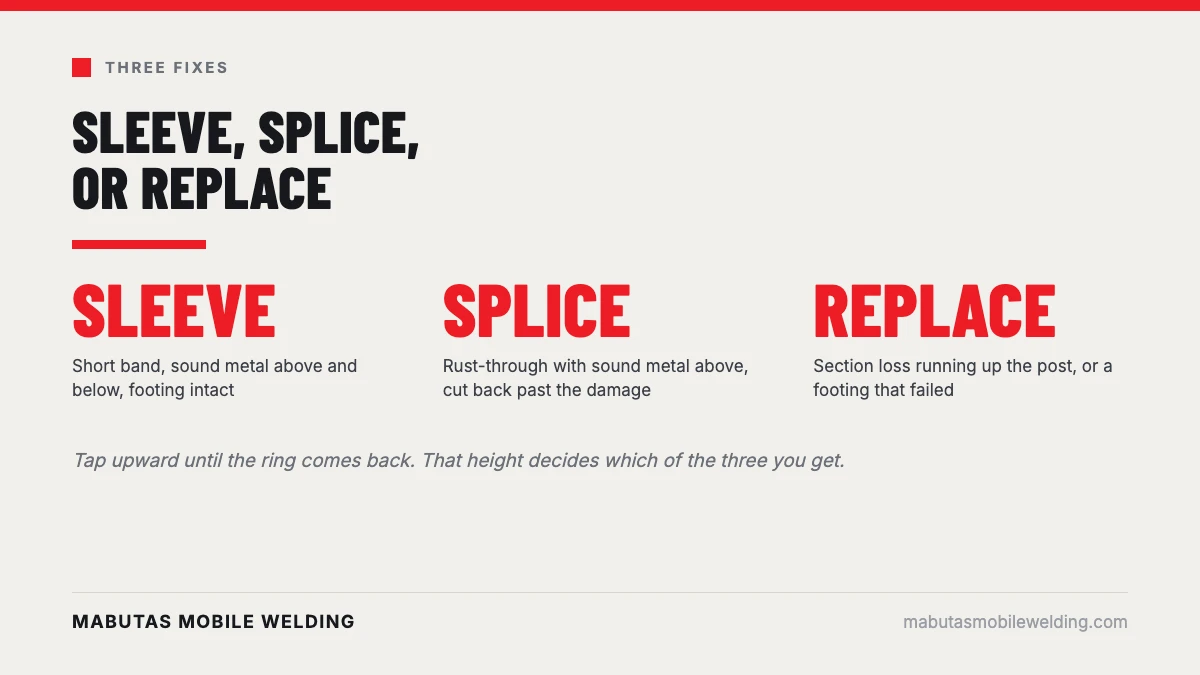
A sleeve bridges the failed band. An external sleeve fits over the post, an internal insert goes down inside it, and either way the point is the same: pick the load up on sound metal above the damage and hand it to sound metal below, so the corroded band stops carrying anything.
It is a legitimate fix on a short corroded band with real metal above and below it, a footing still intact, and a post profile square or round enough that the sleeve sits properly instead of looking like a splint. It is not the fix for section loss running up the post, a footing that has already failed, or a job where the sleeve was chosen because it is quicker than cutting.
Now the part nobody selling these writes down. A bolt-on, no-weld fence post repair bracket is a real product and a reasonable fix in exactly the narrow case above. In every other case it is a cover-up, because it clamps onto metal that is still losing wall thickness inside the sleeve where nobody can see it. The fence looks fixed for a season or two and then tends to go again at the top edge of the bracket, which is now the stress point. If someone hands you a bracket without first probing how far the damage runs, you are buying time, not a repair.
Splicing is the most common right answer on an ornamental fence, and the one that keeps the original ironwork. Cut the corroded section out, back past the damage into metal that rings, weld in a new stub matching the original profile and wall thickness, then dress and finish the joint. Four things decide whether it lasts:
Done properly, a splice on a painted ornamental fence disappears from three feet away. Where the original picket, collar or rail profile has not been stocked in decades, the replacement stub gets made rather than bought, which is custom and decorative metal fabrication rather than an off-the-shelf part.
When the damage runs too far up the post to land a repair on sound metal, the post comes out. Cut it free of the rails, remove or core out the old collar, fabricate a replacement to the original profile, then set it.
How it gets set matters more than people expect. In new concrete the metal wants to be held clear of standing water rather than sitting in a cup that collects it, and the top of the footing wants to shed water away from the post. Where the concrete around the old post is still sound, a base plate anchored to it is often the better call, because it keeps the metal up out of the wet band entirely. That conversion is also the answer when the footing failed rather than the post: if the post rings solid all the way down and the movement you felt was in the concrete, replacing good metal fixes nothing.
Then the panels come back to line and the new work gets primed and topcoated, welds included. A bare weld is the most corrosion-prone metal on the fence.
Paint is a barrier, not structure. It slows corrosion on metal that is still there, which is worth doing. It does not put wall thickness back. Once the section at grade is gone, the steel that was carrying the panel is gone with it, and a coating over the hole buys appearance for a season. Everything else about rust on a wrought iron fence, including what to do about it before it gets here, belongs on the rusted iron fence walkthrough.
Northern Illinois runs the freeze-thaw cycle dozens of times a winter, and every pass opens the gap between post and collar further. Clay soil, which most of this county sits on, holds water around a footing for days after rain. A sprinkler head hitting one post ten times a week will finish that post years before its neighbors, and mulch banked against the base keeps bare metal wet around the clock.
Where the post sits matters as much as how old it is. A post at the end of a driveway apron in Elmhurst or Lombard takes salt spray every time the plow goes past, and that one goes first. A post mid-run behind a hedge in Oak Brook can outlast it by years on the same fence. Heavier older sections hold on longer but hide the damage inside their collars, so on those the tap test is the only thing that tells you anything.
Three things are genuinely worth your Saturday, and they all buy real time. Clear soil and mulch back off the base of every post and leave it cleared. Redirect any sprinkler head that is hitting the fence. Strip and coat the bottom few inches of every post while the metal is still sound, because that is the cheapest repair there is.
Cutting, splicing or re-setting a structural post is where it stops, and the reason is specific rather than a warning label. The repair has to land on metal that is still sound, and the panel has to come back to line afterwards or every post next to it starts carrying load it was never set for. That is the work in wrought iron fence repair across DuPage County, and a mobile rig does it at the fence in the driveway, so nothing gets hauled away and the panels come back to square at the fence.
One post gone at grade is a repair. Most of the posts soft at grade with the rails going too is a different conversation, and it turns on more than the metal. We laid that decision out separately in wrought iron fence repair vs replacement. It is not answered on this page, and it should not be answered from a photo.
Send a photo of the post base and get a quote
Sources: National Park Service, Iron Fence Repair · National Park Service Preservation Brief 27, The Maintenance and Repair of Architectural Cast Iron · AMPP surface preparation standards SSPC-SP 2 and SP 3, hand and power tool cleaning