
One cross-member under the deck is orange and flaking, or a screwdriver sinks into it, or the deck boards over it have started to sag. Search trailer cross member rust repair or replace and you land in forum threads that agree on one thing: replace it if it is rusted through, patch it if it is surface rust. None of them explains how to tell which is which. This post does, member by member, before the trailer goes back under a load.
Surface rust can be cleaned, coated and left in service. Rust that has taken away steel, called section loss, is a different problem, and where on the member it sits decides whether a welded repair or plate makes sense. Paper-thin steel, rust at the joint to the frame rail, or a member that carries an axle or a bunk usually points to replacement.
Orange on the surface is cosmetic when the steel under it is still the thickness it started at. Section loss is when rust has eaten into the steel itself, so the member is thinner than it was built. The two look alike from a few feet away, which is why the sort starts with a tool, not a guess.
Scrape the area with a wire brush or a putty knife down to bare metal. Then probe it with a screwdriver tip and tap along the member with a hammer. Sound steel rings and resists the tip. Rust-thinned steel sounds dull, flakes in layers, dimples under the tap or lets the screwdriver in. Mark every spot that gives, and take photos of each with a tape in the frame.
Sort what you found into three buckets:
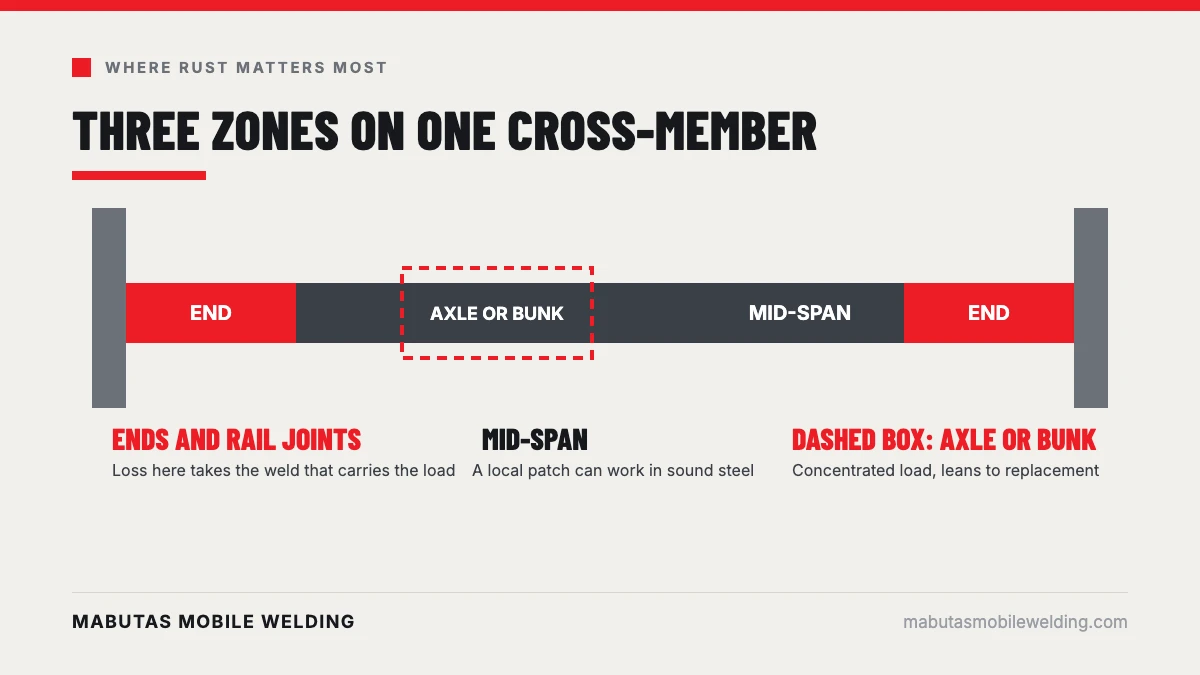
A cross-member is a short beam that ties the frame rails together and carries the deck. Loads do not reach every part of it equally, so the same amount of rust matters more in some places than others. The table sorts the common locations.
| Where the loss is | What it usually means | Likely option |
|---|---|---|
| Surface rust along the member, hard steel under it | Coating has failed, steel is still the thickness it started at | Clean and coat |
| Local pit or soft spot mid-span | Water sat on one spot, sound steel around it | Welded patch or plate |
| Loss at the end of the member | The end holds the weld to the frame rail and sees every load | Replace the member, or cut back to sound steel |
| Rust at the joint to the frame rail | The connection is thinning, and the rail may be too | Replace, and inspect the rail |
| Loss under an axle mount or bunk | This member carries a concentrated load | Usually replace, not patch |
| Holes or edges that crumble | No sound steel left to weld to | Replace |
Read the table from the ends inward. The end of a cross-member is where the weld to the frame rail sits and where the load transfers, so loss there is the most serious. Mid-span loss matters too, but a local patch of sound steel on both sides can be dealt with. Under an axle mount or a bunk, the member is carrying a concentrated load that a plate was never meant to share, which is why those spots lean toward replacement even when the rust looks modest.
Photograph each member from below with a light, and note which side of the trailer it is on. A written list of members, locations and bucket calls turns a vague worry into a scope that can be quoted, and it gives whoever repairs it a place to start. Include the trailer type, whether it is a flatbed, dump or equipment trailer, and how it is used, since a trailer that hauls heavy loads asks more of its members than one that moves lawn equipment.
Rust rarely stops at one member. Water runs along the frame and collects at the same low points on every cross-member, so the one you found first is usually the worst, not the only one. Inspect all of them, and the underside of the frame rails where they meet.
Look at the inside faces of channel and the corners of tube, where water sits and the coating wears first. Tap each member the same way and mark what you find. If one member is far worse than the rest, it may have been in the wrong place for drainage, or something may have been leaking onto it. If several are thin, the trailer is telling you it has aged as a whole, and that changes the repair-or-replace question for the entire deck.
Federal rules for commercial vehicles state that the frame or chassis must not be cracked, loose, sagging or broken. That is a good test for any trailer used for work, whether or not the rule applies to yours.
A welded repair makes sense when the rust is local and the steel around it is sound. The welder cuts back to clean metal, then welds in new steel, either a patch plate over a thinned area or a full section in place of a damaged one. The weld is only as good as the steel it is joined to, which is why a member that is soft for a foot in every direction is not a repair candidate.
A patch plate laid over rust hides the problem. The plate should go on bare steel, after the rusted area has been cut out or ground back, not on top of scale. A plate welded over rust leaves moisture trapped under it, and the member will rust through again from the inside. Ask how the old steel is being dealt with, not only where the new steel goes.
Ask these before you approve a repair:
The zinc question matters on trailers with a galvanized frame, and welding galvanized steel explains what happens when the coating burns off. For a wider view of how far any weld goes, see how strong a welded repair is. A repair is scoped to the sound steel around it, and no one can promise it matches the original member.
Replace the member when there is not enough sound steel to weld to, when the rust sits at the rail joint, when the member carries an axle or bunk load, or when the steel is paper-thin along its length. A new cross-member of the same size and shape is made, cut to fit and welded to the frame rails. That is routine fabrication, and trailer repair in DuPage County covers it on site.
If the rust is bad enough that you are considering a replacement, check the frame rails next. A new cross-member on a thin rail moves the problem to the rail. The earlier guide on whether a cracked trailer frame can be welded covers that case separately.
The cost drivers are qualitative: how many members, how much of the frame is affected, how hard the trailer is to reach, and whether parts have to be made first. Get the scope in writing, with each member listed.
Steel rusts again where water sits. After the repair, the best protection is a clean surface, a good coating and a way for water to leave.
Think of a lawn-equipment dealer yard in Wood Dale, an equipment trailer parked outdoors in a Carol Stream distribution lot, or a utility trailer that spends winters in a Bensenville driveway. Road salt and standing water are what rust a cross-member, and the fleet case is covered under commercial welding in DuPage County.
Cross-member repair and replacement sections are routine on-site work in DuPage yards, scoped on the call once the photos and the member locations are known.
The front of the trailer carries its own repair-or-replace call, and what can be welded back on a trailer hitch, coupler or tongue sorts that damage into welded, replaced or condemned.
Send photos of the cross-members and get a quote
Sources: 49 CFR 393.201, Frames (Legal Information Institute, Cornell Law School)