
The coupler wobbles on the ball, or there is a hairline crack at the weld where it meets the tongue, or the tongue itself has a bend nobody can account for. Search trailer hitch coupler weld repair and the threads split three ways: weld it, bolt on a new coupler, or take it to a pro. This is the one weld on a trailer that holds the trailer to the truck, so the useful question is which damage can be welded back and which means the part is finished. This post sorts it.
Damage to a coupler, tongue or hitch falls into three outcomes: welded back, replaced, or condemned. A crack in a weld in otherwise sound steel can often be repaired. A crack in the parent metal, a stretched or heat-damaged member, or a bent tongue usually means the part is replaced. Until it is sorted, the trailer is not towed.
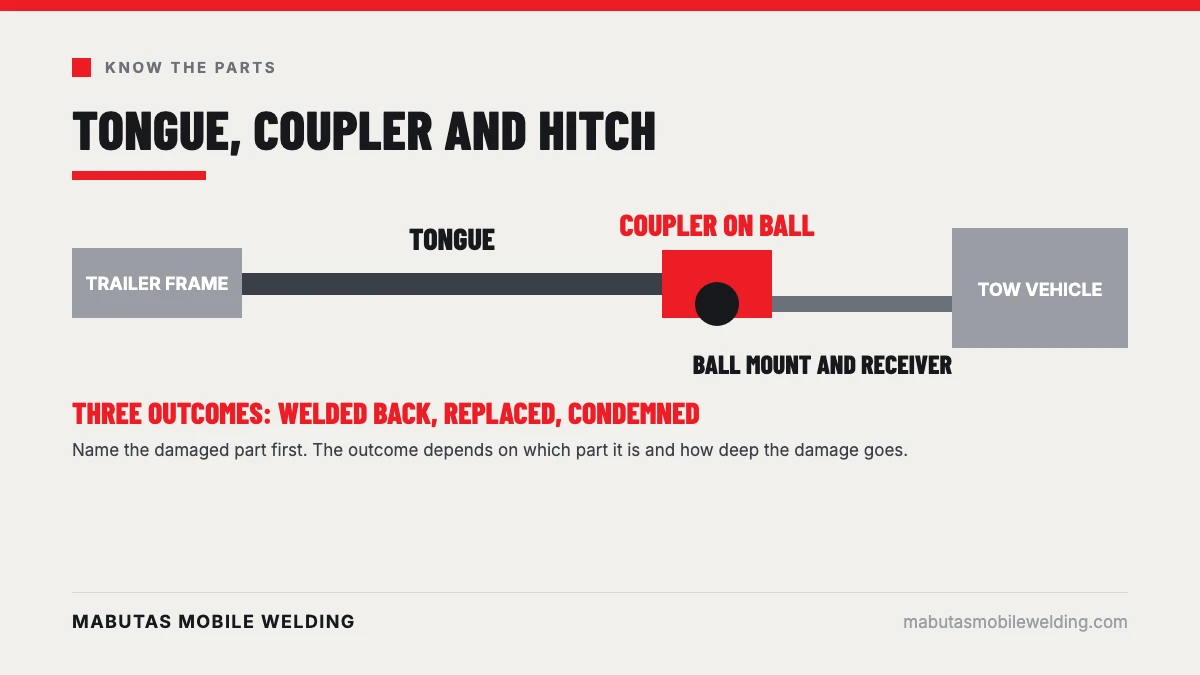
Three parts are involved, and people use the words loosely. The coupler is the socket at the front of the trailer that closes over the ball. The tongue is the steel member that runs from the trailer frame forward to the coupler. The hitch is on the tow vehicle: the receiver, the ball mount and the ball.
The reason to name the part is that the outcome changes. A coupler is often a bolt-on or welded-on component that can be replaced as a unit. The tongue is part of the trailer frame, so damage there is a frame question. The hitch on the vehicle is a separate system with its own ratings. Stand at the front of the trailer with a light, and write down which part shows the problem and what the damage looks like.
Most coupler and tongue trouble shows itself in a few ways. The table sorts them, with the outcome each one usually leads to. It is a guide to the conversation, not a ruling, because the final call is made with the part in view.
| What you see | What it usually means | Likely outcome |
|---|---|---|
| Hairline crack at the toe of a weld, steel around it sound | The weld fatigued, the steel did not | Can often be ground out and welded back |
| Crack running into the tube or plate beside the weld | The parent metal itself has failed | Replace the part |
| Bolt holes stretched into slots | The part has been loaded past what it was built for | Replace the part |
| Tongue bent or sagging | The member has yielded | Usually replace the tongue section, not straighten |
| Latch or lock worn, loose on the ball | Wear in the moving parts | Replace the coupler |
| Discolored steel, heat checks or burn marks near a weld | Previous heat or a poor repair changed the metal | Treat as condemned until inspected |
Read it from the weld outward. A crack that stops in a sound weld toe is a different thing from a crack that has gone into the steel. Once a crack is in the parent metal, a new weld on top of it does not make the steel under it any better, which is why that case moves to replacement.
Photographs help more than a description. Take the coupler from the front, from each side and from underneath, with a tape or a coin in the frame for scale. Shoot the weld at the point where the coupler meets the tongue, the latch and the lock from both sides, and any spot where paint is cracked or rust is bleeding out of a seam. Add the trailer's make, model and year from the plate, and a note on how it is used. A trailer that carries heavy equipment every week asks more of its coupler than one that moves a pair of mowers on weekends, and that changes how much margin the repair needs.
A repair is reasonable when the steel on both sides is clean and sound and the failure is in the weld itself. The old weld is ground out to good metal, the joint is prepared, and a new weld is laid in. In the same category: a coupler that has to be re-set square on a clean tongue tube, or a gusset that needs to be re-attached to sound steel.
Ask for these things when you request the repair:
A welded repair is scoped on inspection. Some parts come off the trailer as a result, and replacing a part is a normal outcome of a good inspection. For the frame side of the question, whether a cracked trailer frame can be welded covers the rails and cross-members. For the general limits of any weld, see how strong a welded repair is.
Replace the coupler when its socket or latch is worn, when it has stretched bolt holes, or when it is cracked in the parent metal. Replace a tongue section that is bent, since a member that has yielded has lost the strength it was built with. A new coupler is welded or bolted to sound steel that has been checked first.
Some parts are condemned, which means they are done. That includes anything with a crack in the parent metal that has traveled, a member showing heat damage or old burn-through, or a part so worn that the repair would be more of a rebuild than a weld. Condemned parts are cut off and replaced with new steel, not patched.
Do not tow the trailer in the meantime. A coupler that lets go on the road is not a repair problem anymore. If the trailer has to move, it can be moved by other means while the part is looked at. The same goes for a trailer whose latch is questionable: an unreliable coupler is a stop, not a nuisance.
Federal rules for commercial vehicles are a useful yardstick even for trailers they do not cover. They call for towing devices that are structurally adequate for the weight being drawn, a locking device that prevents accidental separation, and safety chains or cables that keep the trailer attached if the coupling fails. Safety chains are the backstop, never a reason to tow a cracked coupler.
If the trailer is a named model, a recall may cover the coupler or its weld. A recall can cover a coupler or the weld that holds it, and the remedy is arranged through the maker. It is worth knowing before any weld goes on the part.
Look up the make and model at the federal recall site, which also takes a trailer's VIN. Have the plate on the trailer tongue or frame in front of you: the make, model, year and VIN are all usually on it. If a recall covers the part, that route comes first. If nothing comes up, the repair goes ahead as described above.
A new weld on a hitch component needs a second look once it has been loaded. Recheck it after the first few loaded trips, and then at each season change.
The same inspection logic applies to the rest of the trailer. Rust under the deck can be a sign that the hardware around the tongue is aging, and rusted trailer cross-members covers how to sort that out.
Hitch and coupler wear is hardest on the trailers that are used the most, such as an equipment trailer that moves between job yards or a utility trailer that makes regular runs. For fleets and contractors with several trailers, the work sits under commercial welding in DuPage County, and trailer repair in DuPage County lists the hitch and coupler work.
Hitch and coupler repair is on-site work in DuPage, scoped on the call once the part, the damage and the trailer are known.
Send photos of the coupler and tongue and get a quote
Sources: 49 CFR 393.70, Coupling devices and towing methods (Legal Information Institute, Cornell Law School) · Vehicle and trailer recall lookup (NHTSA)