
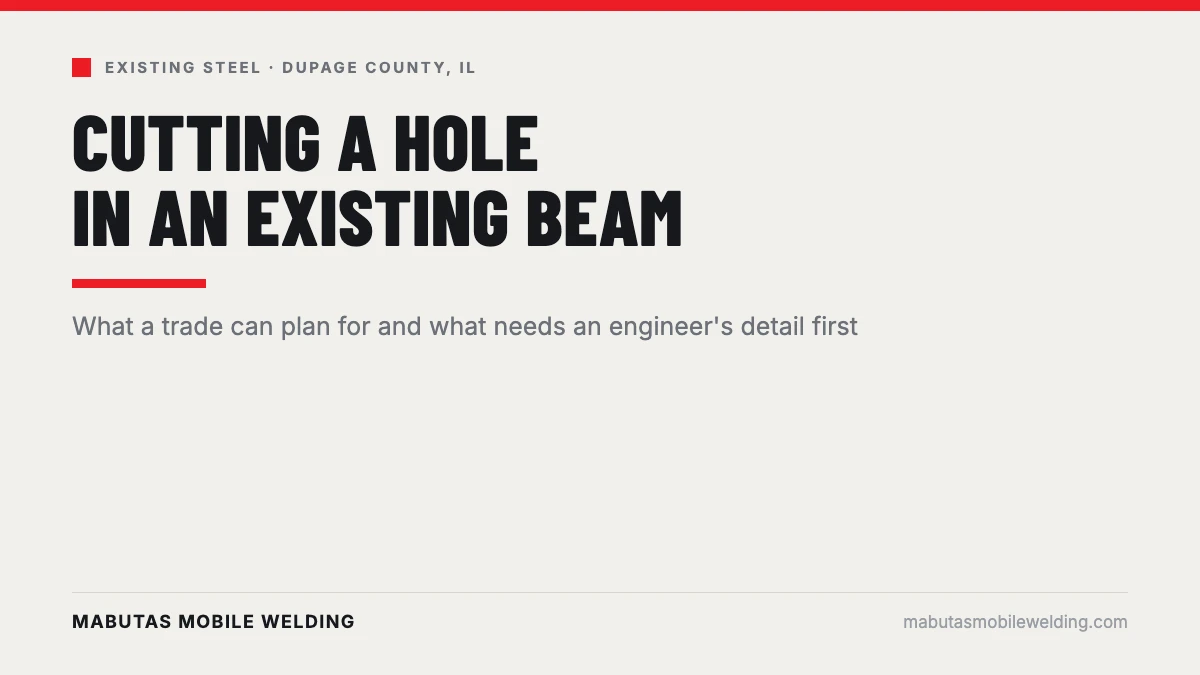
A duct, a conduit run or a new doorway has to get past a steel beam, and the schedule is already tight. Search cutting holes in existing steel beam and the answer is spread across forum replies, a drill-bit maker's how-to and a planning document from another country. This post puts it in the order a project manager needs it: where the hole goes, which openings need an engineer's detail before anyone cuts, what to send, and how the cut is made.
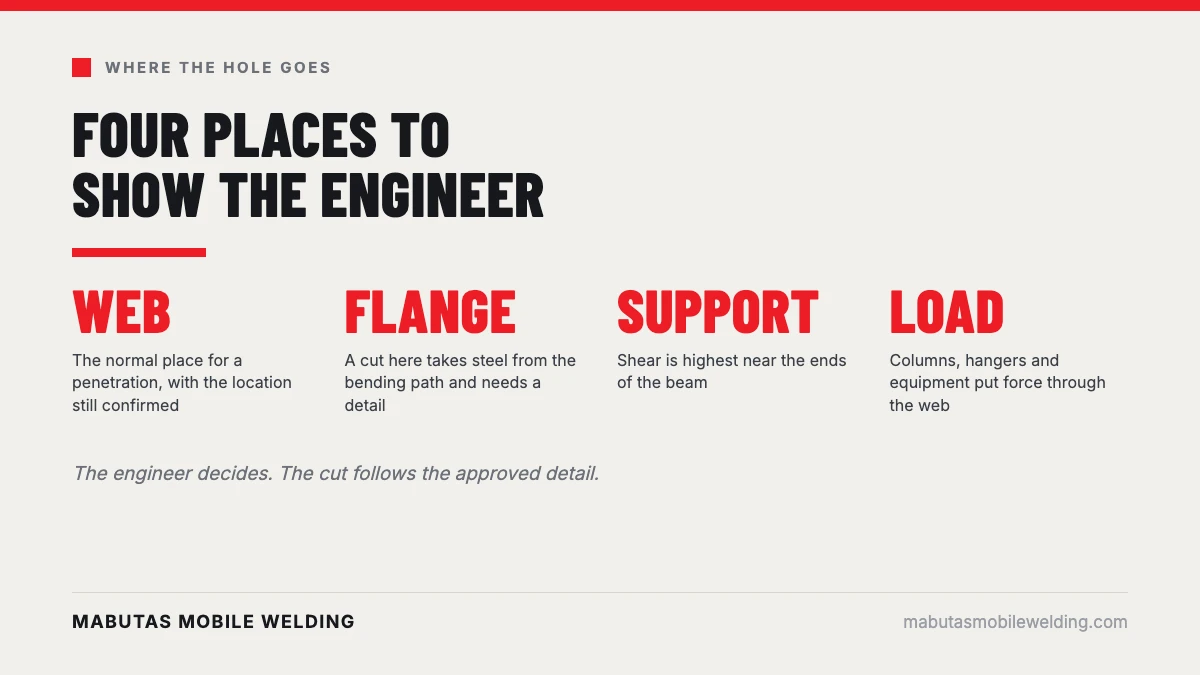
Where the hole goes matters more than how big it is, because a beam carries its load in different ways in different places. A small hole in a lightly stressed spot may be fine. A hole in a flange, near a support, under a point load or beside another hole is a call for an engineer, in writing, before a tool touches the steel.
A steel beam is not the same at every point along its length. The flanges, the wide top and bottom edges, carry most of the bending. The web, the thin plate between them, carries most of the shear, and shear is highest near the supports. A hole removes steel from whichever part it lands in, so the same hole can be harmless in one spot and a problem in another.
Three pairs of locations are worth marking on a sketch before you call anyone. The first is web or flange: a hole through the web is the normal case for a penetration, while a cut into a flange takes away steel that is doing most of the bending work. The second is mid-span or near a support: web openings sit more comfortably away from the ends of the beam, where shear is highest. The third is clear of a load or under one: a column landing, a hanger or a rooftop unit sitting on the beam puts concentrated force right where you might want to cut.
Size and spacing count too, and the published design guidance deals with them directly. AISC's Engineering Journal publishes design aids for web openings, built on AISC Design Guide 2, and the engineer works from published guidance, not from a rule of thumb heard on a job site. Your job is to bring the location, not to pick a number.
Most of the openings that stop a project fall into the same few situations. Use the table as a pre-call checklist: if your opening matches a row, expect the engineer to ask for it and to put the answer in writing.
| Situation | Why it matters | Who decides |
|---|---|---|
| Any cut into a flange | The flanges carry most of the bending, so removing steel there changes the beam's capacity | Engineer of record |
| A large web opening | The bigger the opening, the more of the web's shear path is removed | Engineer of record |
| A hole near a support or end connection | Shear is highest near the supports | Engineer of record |
| A hole under a column, hanger or equipment load | Concentrated force passes through that part of the web | Engineer of record |
| Several holes close together | Neighboring openings affect each other, so the group is checked as one | Engineer of record |
| Any beam that carries other beams or columns above | A transfer member supports much more than its own floor | Engineer of record |
| A small round hole in a lightly stressed web, clear of loads | Often acceptable, but the engineer still confirms the location | Engineer, quick review |
The approval comes from the engineer of record for the building, or an engineer the owner hires to look at the beam. A welder or fabricator does not approve a penetration, stamp a detail or decide that a member can lose steel. That is the engineer's call, and the work follows the answer.
A good package gets a fast reply. Send the drawings if they exist, or at least the floor plan with the beam marked. Add the beam size from the stamp or the web, or a photo of it with a tape in the frame. Add the exact size, shape and position of the opening, measured from a support. Note what sits on or hangs from the beam. Add photos of both sides and the underside, and say whether the beam has sprayed fireproofing or paint that will need patching afterward.
If the building has no drawings, that does not end the conversation. An engineer can assess the beam on site, identify the member and the loads on it, and give a written answer for a specific opening. Expect that to add time, so start it early. If an earlier owner or tenant already cut holes in the same beam, tell the engineer where they are and when they were made, because every existing opening counts toward the group.
When an engineer approves an opening with conditions, the condition is often reinforcement. In practice that means a ring or a doubler plate welded around the opening, or stiffeners welded beside it, sized and placed by the detail. The idea is to put back the stiffness and strength the removed steel was providing locally.
The detail governs everything about it: plate thickness, weld size, how far it extends and the order the welds go in. The helpful question for you is simple. Ask the engineer whether the detail calls for reinforcement before you ask anyone to price the job, because a reinforced opening is more work than a bare hole. Reinforcing plates and rings are cut and shaped before they are welded on, which is where steel fabrication for DuPage County projects comes in. Welded reinforcement on existing steel, including the question of how much a finished weld holds, is covered in how strong a welded repair is.
There are two common ways. Round holes are usually drilled or cut with an annular cutter, a hollow bit that removes a ring of steel and leaves a clean edge. Larger or rectangular openings are usually cut with a torch or a plasma cutter, and the corners of a rectangular opening are rounded, not left square, because a sharp inside corner concentrates stress.
The edge matters. A clean, smooth edge is part of the detail, and a rough torch cut may need grinding before the engineer will accept it. Confirm the method in the quote, along with who grinds, who primes the cut edge and who patches the fireproofing.
Thermal cutting makes sparks and slag, so in an occupied building the permit and fire watch rules apply. The order of those steps is in what hot work in an occupied building requires. If the beam is carrying load while it is cut, read welding to steel under load as well, because shoring may be part of the plan.
A cut in a beam disturbs more than the steel. Sprayed fireproofing or an intumescent coating around the opening is damaged and has to be patched to the rating the building needs. Bare steel at a cut edge needs primer or paint so it does not rust. A pipe, duct or conduit passing through the hole may need its own sleeve, sealant or firestop where it crosses the web.
Put those items in the scope before work starts, with a name beside each: who cuts, who primes, who patches the fireproofing, who seals the penetration. Scopes slip when the last three items belong to nobody. A short list on the quote, and a walk-through of the opening with the trades involved, closes that hole before the first cut.
It also helps to decide the order of work. The usual sequence is approval, layout and marking, cutting, edge finishing, reinforcement if the detail calls for it, coating, then the trade's own pipe or duct. Putting the pipe in before the reinforcement is welded means the work may have to be done twice.
Sometimes. A duct can drop below the beam, a pipe can be routed to the space between beams, and a conduit can turn before it reaches the steel. Offsets and hangers cost some ceiling height and a few fittings, but they leave the beam alone and can remove the engineer's review from the schedule altogether.
Before you commit to a penetration, ask the designer whether a route around the beam was considered. If the answer is yes and it was rejected for height or cost, the engineer's review is worth the wait. If the answer is no, it costs one question to find out.
Picture an Elmhurst tenant fit-out where a new duct run meets a steel beam, a Lombard office renovation that adds a doorway through a bearing line, or an Itasca warehouse adding a sprinkler main along a row of beams. In each, the first question is the same: who is the engineer of record, and has the opening been shown on a drawing?
For field cuts and modifications on existing members, the scope is set on the call, with the engineer's detail in hand, through on-site structural welding for builders in DuPage County. Cutting holes in existing steel beam members and welding the reinforcement is routine field work when the opening has been approved.
Send the opening details and get a quote
Bollards raise the same repair-or-replace question at a smaller scale. The guide to a damaged steel bollard walks through when a re-weld holds and when the post comes out.