
The loader bucket has a crack through the ear. The trailer's ramp hinge has torn loose. A rack upright has been folded by a forklift. The first question is not who can weld it. It is whether the thing can be fixed where it sits, or whether you lose it for a week. Search field welding vs shop welding repair and you mostly learn that both are possible, which is true and does not help you decide. This post gives the physical reason a repair goes one way or the other, so you can predict the answer before you call anyone.
Most repairs on a working asset can be made where it stands, to the same standard a shop would hold, if position, cleanliness and weather are under control. The repairs that cannot are decided by physics, not by preference, and you can spot them before you make a call.
Start with movement. Can the asset get to a shop without being dismantled or damaged on the way? A trailer with a cracked frame rail should not be towed. A bucket comes off a machine in an hour. A rack upright is bolted to a slab under a loaded bay. A canopy column is part of the building. That alone settles a lot of jobs.
Then standard. Can the weld be made to the same quality where the asset stands? That depends on position, access, cleanliness and weather, and most of this post is about those four things.
Then downtime. How many hours is the asset out of service for a site visit, against how many days for transport, a shop queue and the trip back? Answer all three before you call anyone and you will already know which way the job goes.
A rig carries its own power, so a weld can be made in a yard with no outlet in sight. It carries more than one process: stick for wind and dirty steel, wire-fed processes for speed on clean steel, and TIG for stainless and aluminum when conditions allow. It carries grinders, a cutting torch, clamps, and enough steel to make a gusset or a patch plate.
What it does not carry is a controlled room. There is no fixture table, no blast cabinet, no oven, no mill, no press, no overhead crane, and no way to turn a thousand-pound part over so the joint faces up. Describe the location on the call: surface, access, and whether there is cover from wind and rain.
A weld is made in one of four positions: flat, horizontal, vertical or overhead. Flat and horizontal are one kind of job. Vertical and overhead are another, slower and harder, fighting gravity to hold a molten puddle where it belongs. The welding codes qualify welders and procedures by position for this reason, and AWS D1.1 treats the same joint as a different task upside down.
In a shop, the part is rotated so every weld is made flat. In the field, the weld is made where the crack is, often under a trailer, inside a bucket, or against a wall. A weld you cannot get a torch square to is the weld that fails first. Before calling, photograph the joint from where a welder would have to stand, not from where you are standing. If that photo is of the underside of something a foot off the ground, say so.
Grease, paint, rust, mud, hydraulic oil and moisture all end up in the weld if they are not removed first, and each one makes porosity or cracking more likely. In a shop they are controlled: degreased, ground to bright metal, dried, welded on a clean bench. In a yard they are handled where the asset stands: ground to bright metal at the joint, with oil leaks stopped before the arc.
Fume matters too. OSHA's fact sheet on welding fumes covers what coatings and contaminants put in the air when they burn, and in a tight space that is a ventilation problem as well as a quality one. Clean access is something the customer can supply, and it changes the answer. A bucket pressure-washed the night before with the ear ground back to bright steel is a field job. The same bucket caked in clay with oil running out of the crack may not be.
| Condition | Why it cannot be done in the yard | What it looks like on your asset |
|---|---|---|
| The joint has to be fixtured or rotated | A long or distorted part must be held true while it is welded, or it moves as it cools and ends up out of square. That takes a table and clamps the size of the part | A bent trailer frame that needs to be pulled straight before welding; a gate frame that has to be built square; a long rail that twisted when it cracked |
| The surface needs blasting or controlled prep | Heavy mill scale, deep pitting or a coating that cannot be ground off completely needs abrasive blasting, which is a cabinet, not a grinder | A badly pitted frame being rebuilt rather than patched; anything being fully recoated after repair |
| The section needs preheat and controlled cooling | Thick or crack-sensitive steel and some castings have to be brought up to temperature before welding and cooled slowly after, or the weld cracks as it shrinks. Torch preheat works on small parts; a large one needs an oven or electric heating blankets with a controller, which a welding rig does not carry | Heavy equipment castings, thick bucket components, a part that has already cracked twice in the same place |
| Something has to be machined, pressed or straightened afterward | Welding moves metal. If a bore, a pin hole, a flange face or a mating surface has to be back within a tolerance, it is machined after the weld, on a mill, a lathe or a portable line-boring machine, none of which a welding rig carries | A worn pin bore being built up and bored; a bearing seat; a hitch coupler that has to fit a ball exactly |
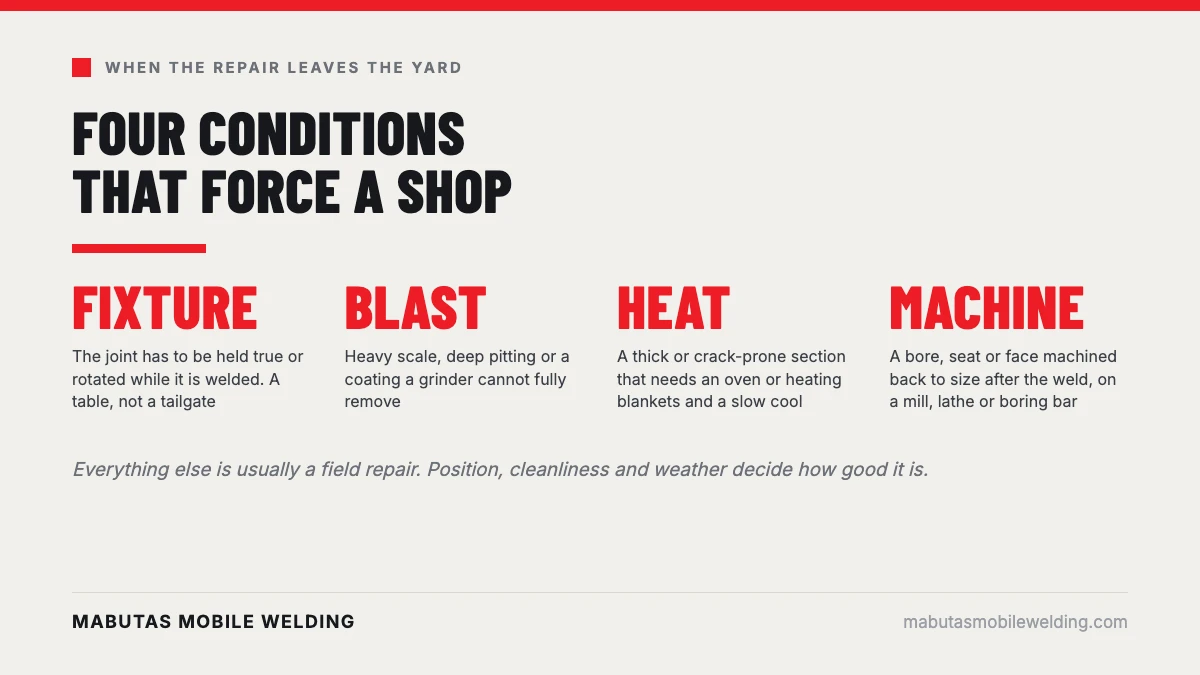
If none of the four applies, it is probably a field job. If one does, it probably is not, and a welder who says so on the phone is saving you a wasted visit.
Ask what has to be true when the repair is finished, not only whether it can be stuck together. A cracked ear can be welded in the field. A cracked ear whose pin bore then has to be round to a few thousandths needs a boring bar after the weld, which is machining work, not welding. A hinge can be welded back on a ramp. A hinge that has to line up with a second hinge so both pins slide freely is a fixturing job.
Coatings decide it too. A field repair gets a wire brush, a primer and a top coat from a can, which is fine on a trailer. A repair that has to be fully recoated to a specification is a shop job because of the blasting and the paint booth, not because of the weld.
Wind strips the shielding gas off a MIG, gas-shielded flux-core or TIG weld and lets air into the puddle, which shows up as porosity. AWS D1.1 does not allow gas-shielded processes in a draft or wind unless the weld is sheltered, so on a windy day the choices are a windbreak, a self-shielded process, or another day. Stick and self-shielded flux-core are field processes for a reason.
Cold is the other problem. Cold steel pulls heat out of the weld fast and makes cracking more likely, and the code does not allow welding until the steel around the joint is brought up to its minimum temperature. In a DuPage January that means preheating with a torch, working under cover, or waiting. A heated shop bay is a real February advantage.
Field repair: the asset is down for the hours the welder is there, plus any prep you do before. Shop repair: the asset is down for unbolting or rigging, loading, transport, the shop's queue, the repair, transport back, and refitting. For a bucket or a trailer that is usually days against hours, and the field wins.
Sometimes it does not. A small part that unbolts in ten minutes and rides in a pickup can be at a shop and back before a rig could be scheduled, and if it needs machining anyway the shop was the only answer. A repair that would take three field visits because of weather and access is slower than one shop trip. Work the real number for your own asset in hours out of service.
If the work is inside an occupied building, a permit and fire-watch layer applies before any of this starts, and that is its own subject. Run the list, then send the photos.
Working assets across DuPage County split along the same lines. Equipment and lawn-crew trailers in Wood Dale and Bensenville yards, where a cracked tongue or failed crossmember makes a tow the riskier choice. Dock plates, levelers and bollards at Glendale Heights and Carol Stream warehouses, bolted to the building. Compact excavators and skid steer attachments on Addison and Naperville job sites, where the bucket could come off but the machine cannot leave.
When the asset is a bucket, boom, attachment or machine frame, that is on-site heavy equipment repair across DuPage County. When it is a frame, tongue, ramp or crossmember, it is mobile trailer repair in DuPage County. Whether the crack itself can be welded is covered in what a proper trailer frame crack repair involves, whether the bucket is worth fixing at all in how a cracked bucket gets judged for repair or replacement, and what the finished repair will carry in how strong a welded repair is under steady and repeated load. This post only decides where.
Field welding vs shop welding repair comes down to three questions and four conditions. Answer the questions, check the list, and the welder on the phone should land where you did. If he does not, ask which of the four conditions he is seeing.
For a trailer, the field route is laid out by town in trailer welding repair in Bensenville and trailer welding repair in Elmhurst.
Send photos of the repair and get a quote
Sources: American Welding Society, AWS D1.1/D1.1M Structural Welding Code, Steel · OSHA Fact Sheet, Controlling Hazardous Fume and Gases during Welding · OSHA 29 CFR 1910.252, Welding, Cutting and Brazing, General Requirements