
Almost every guide on how to fix a rusted wrought iron fence stops in the same place: wire brush it, prime it, paint it, done. On plenty of fences that is the right answer. On plenty of others, rust has already eaten through metal that was holding weight, and a fresh coat over it is a cosmetic fix on a structural problem. The difference takes ten minutes and a screwdriver to find. Here is how to tell which fence you have, what is worth your Saturday, and where it stops being a paint job.
Surface rust is yours to fix. Strip it back to bare metal, prime it, coat it. Rust that has gone through the metal is a welding job, because the steel that carried the load is gone and paint does not put it back.
Rust on iron is not one condition. It is four, and only the first two are a homeowner job.
Here is how to sort your own fence into those four, with a screwdriver and a work glove:
If the tests came back clean, then how to fix a rusted wrought iron fence is a preparation job, and preparation is most of the work. The coating is the easy part and it is not what fails.
Get back to sound metal. A wire wheel on an angle grinder handles the straight runs, a wire cup or a hand brush gets into scrollwork, and coarse abrasive opens up the pitted areas. The National Park Service guidance on architectural iron is blunt about why this matters: any corrosion left under a new coating keeps working underneath it, and the paint film just hides the damage while it lifts.
Do the parts nobody does. Undersides of rails. The face that sits against a hedge. The inside of every joint where two members meet. The last three inches at grade. Those spots stay wet longest, so they are where the fence comes back to you first.
On rust converter: it turns remaining oxide into a more stable film and it earns its keep deep in a pit you cannot reach with an abrasive. It is not a replacement for taking the loose material off, and it does nothing about metal that is already gone.
Prime the same day you strip, because bare iron flash-rusts within hours in an Illinois summer. Work a rust-inhibitive metal primer into the pits and joints rather than skimming over them, then topcoat the whole member instead of the visible face. Before you coat, pull mulch and soil back off the bottom of each post, and leave it pulled back.
| What you find | Yours or a welder's | What the fix is | If you leave it |
|---|---|---|---|
| Surface rust, metal solid underneath | Yours | Strip back to bare metal, prime, topcoat all faces | Turns to scale over a winter or two, then starts pitting |
| Flaking scale, metal pitted but present | Yours, with more abrasive work | Grind or wire-wheel the scale off, fill nothing, prime into the pits | Pits deepen until one of them goes through |
| Rust-through on a picket | Welder | Cut the picket out, fabricate and weld in a replacement to match the profile | The picket breaks off, usually at the bottom rail |
| Rust-through on a rail | Welder | Splice in new stock of matching section, then refinish the joint | The rail is carrying the pickets, so the panel starts to sag |
| Post soft or holed at the concrete line | Welder | Sleeve, splice or replace, depending on how much sound metal is left above the band - see the post-at-the-base breakdown | The post lets go at grade and takes the panel with it |
| Footing cracked or heaved, post still sound | Welder | A support repair rather than a metal one - see the post-at-the-base breakdown | The lean gets worse every freeze and loads the neighboring posts |
There are four findings that end the coating conversation. Any one of them is enough.
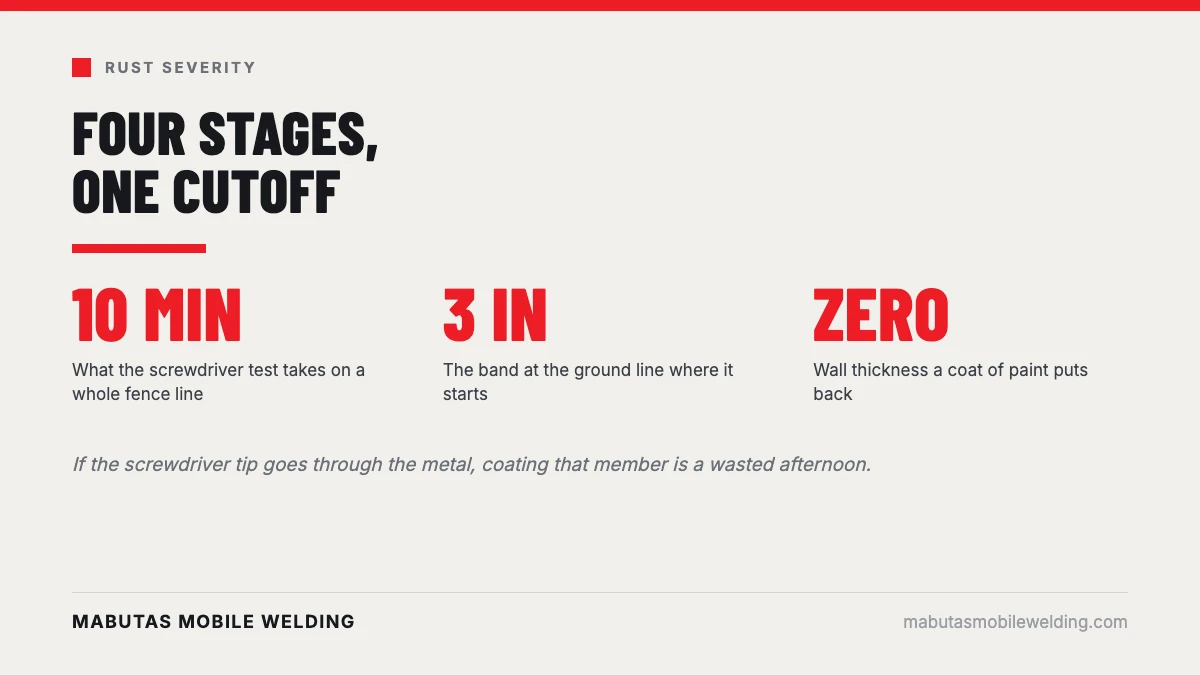
Paint is a barrier. On metal that is still there it slows the next round of corrosion down, which is a real and useful thing. It is not structure, and it does not put wall thickness back. Once a member has lost section, the steel that was carrying the load is gone, and a coating over the hole buys appearance until the next freeze finds it. Nobody ruins a fence by painting it. People ruin fences by painting instead of fixing them, and then finding out in February.
The repair work itself is not exotic. It is four moves, chosen by what the metal will still support.
The first is cutting the failed section out back to sound metal and welding in new stock that matches the original profile and wall thickness. On an ornamental fence this is usually the right answer, because it keeps the original ironwork and from three feet away the repair disappears.
The second is fabrication, for the parts you cannot buy. Older runs use picket profiles, rail sections, collars and finials that have not been stocked in decades. Making one to match is custom and decorative metal fabrication, and it is the difference between a fence that looks repaired and one that looks untouched.
The third is the support, when the problem is the post or its footing rather than the fence above it. That one has its own three-way method call and it is set out in the post-at-the-base breakdown.
The fourth is finishing, and it is the one people cut. A bare weld and the ground-back area around it are the most corrosion-prone metal on the whole fence, so left unprimed the repair becomes the next rust line within a season.
Almost all of it happens in the driveway. A mobile rig brings power, gas and steel to the fence, so panels do not get hauled to a shop and the run comes back to line at the fence. That is the shape of wrought iron fence repair across DuPage County on a residential property.
Corrosion needs water, oxygen and time. Northern Illinois supplies all three on a schedule.
Freeze-thaw cycling is the engine. Water gets into a joint or the gap between a post and its collar, freezes, opens the gap a little wider, thaws, and goes deeper next time. A single winter here runs that cycle dozens of times. Deicing salt off the road and the sidewalk then lands in exactly the band at the base where the water is already sitting, and salt moves corrosion along faster than plain water ever will.
The rest is the yard itself. A sprinkler head that soaks one post ten times a week will kill that post years before its neighbors. Mulch and soil packed against the base hold moisture against bare metal around the clock. Clay soil, which most of this county sits on, drains slowly enough that a footing can stay wet for days after rain.
The older ornamental runs around Hinsdale, Oak Brook, Naperville and Wheaton are heavier sections with more joints and collars, so they last longer but hide corrosion inside the connections. Newer fence lines through Villa Park, Elmhurst, Lombard, Addison, Bensenville and Carol Stream tend to be thinner-wall hollow pickets and rails, which rust from the inside out. That is why the tap test beats the visual one. On the oldest runs some components are cast rather than wrought, and cast parts crack rather than bend - a different repair with its own rules about heat and filler. Railings on stoops and stairs fail on another clock again, at their base plates and wall anchors, so if it is a railing worrying you, check whether a loose exterior railing is still safe instead.
Short version: if the corrosion is scattered and the posts are sound, repair wins on almost every ornamental fence, because the original ironwork is worth keeping and the damage is local. If most of the posts are soft at grade and the rails are going too, the math changes. That decision has its own moving parts, and we wrote it up separately in wrought iron fence repair vs replacement. It is not a call to make from a photo.
Send a photo of the rust and get a quote
Sources: National Park Service Preservation Brief 27, The Maintenance and Repair of Architectural Cast Iron · National Park Service, Iron Fence Repair · AMPP surface preparation standards SSPC-SP 2 and SP 3, hand and power tool cleaning