
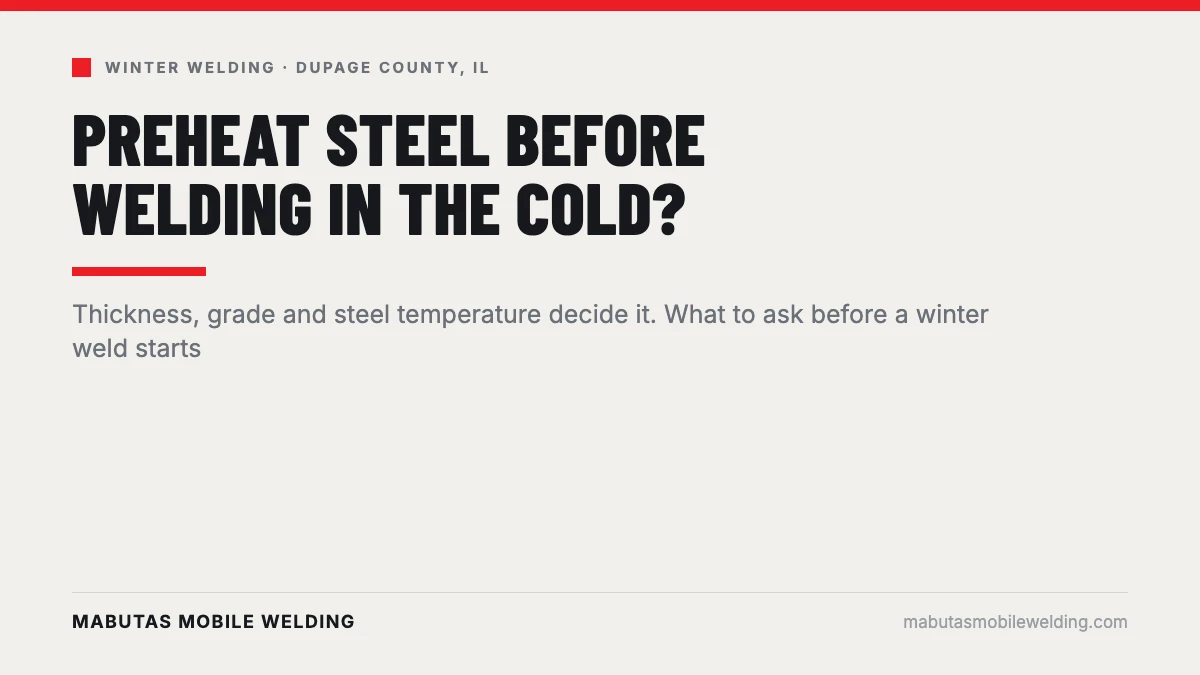
The steel has been sitting outside all night, the forecast says 20 degrees, and a weld is on the schedule. Should you preheat steel before welding in cold weather, or is that a thing welders do to look careful? Search the question and you find forum threads where posters disagree and guides that say "it depends on grade and thickness" and stop there. It does depend. This post gives you the short list of things it depends on, so you can ask the right question before a winter weld starts.
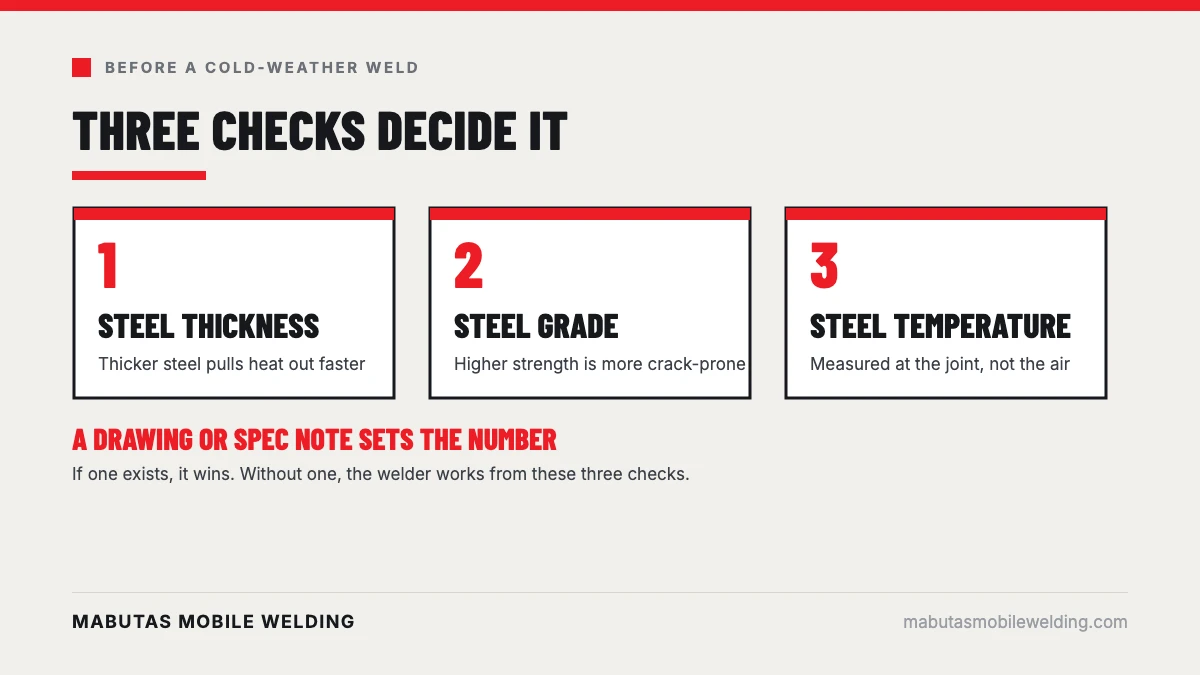
Sometimes. Preheat is not a cold-weather ritual, it is a response to how fast a weld cools. Thicker steel and colder steel both make a weld cool faster, and a fast-cooled weld in crack-prone steel, such as higher-carbon or higher-strength grades, is easier to crack. If a drawing or specification names a preheat, that wins. If it does not, the welder decides from the steel in front of them.
A weld is molten metal that has to cool and settle into the steel around it. In cold air, and especially in cold steel, the heat leaves the joint quickly. A fast-cooling weld can end up hard and brittle in the narrow band beside it, and that is where cracks start.
TWI, a welding research and engineering organization, describes the cracking that results as needing three things at once: hydrogen from the welding process, a hard, crack-prone structure in the steel, and tensile stress on the joint. It also notes that these cracks can show up many hours after the weld is finished, so a joint that looks fine when the welding stops is not proof. Preheat, in TWI's words, slows the cooling rate and lets some hydrogen diffuse away. That is the whole job of preheat: slow the cooling down so the weld has time to settle.
So the question is never "is it cold?" on its own. The question is whether this steel, at this temperature, will cool fast enough to risk a hard, cracked joint. The next sections are how you answer that.
A welder sizing up a winter job is looking at three things. You can look at them too, and most of the answers are on the drawing, the mill paperwork or a tape measure.
| Check | What it changes | Where to find it |
|---|---|---|
| Steel thickness | Thicker steel pulls heat out of the weld faster, so it asks for more preheat than thin steel | Drawing, a tape or caliper on the member |
| Steel grade | Higher-strength and higher-carbon steels are more crack-prone than plain mild steel | Mill test report, drawing note, markings on the steel |
| Steel temperature at the joint | Colder steel cools the weld faster, so the same joint that is fine in a warm shop may not be on a frozen morning | A surface thermometer on the steel, not the air temperature |
Notice that air temperature is not on the list. Steel left out in the sun on a cold day can be well above the air, and a steel member that spent the night in the shade can be well below it. The number that matters is the temperature of the steel at the joint.
You do not need to run these checks yourself. You need to know they exist, so that when you call about a winter job you can say what the steel is, how thick it is, and whether there is a drawing, and so the answer you get back is about your steel and not a general rule.
If a project has engineering behind it, the drawings or the project specification may name a preheat. On a commercial or structural job, that is common. When it does, that number is the number. It is not up for negotiation on a cold morning because the schedule is tight, and it is not something a welder overrides because the steel "feels warm enough."
The reverse is also true. A repair on an existing piece of steel often has no drawing at all. In that case the welder works from the steel in front of them, using the thickness, grade and temperature checks above, and from their own judgment of the joint. If you are an owner or a general contractor and there is a spec note you have not shared, share it before the work starts.
Find it on the drawing or in the specification package, usually in the welding notes. If you cannot find one, say so on the call. "There is no spec" is useful information, and it changes who is making the decision.
A lot of ordinary repair work involves thin mild steel: a section of fence, a railing picket, a small bracket, the thin wall of a tube. Thin steel does not pull heat out of a weld the way a thick plate does, and it usually does not need the kind of preheat a heavy beam splice does. In cold weather the welder may still warm the joint, mostly to take frost and moisture off it, but this is a very different job from a heavy structural weld.
Where the line falls depends on the steel, and no one can draw it for you from the other side of a screen. What you can do is place your job on the spectrum. A light repair on thin mild steel sits at one end. A thick member, a high-strength plate or a joint that carries a major load sits at the other. The closer your job is to the second end, the more the preheat conversation matters. For the load side of that decision, welding to steel that is already carrying a load covers the questions that come with it.
Cold steel is often wet steel. A piece that comes out of a freezing night can be coated in frost, and a piece that is brought into warmer air can collect condensation within minutes. Moisture on a joint can be a source of hydrogen, and hydrogen is one of the three ingredients in the cracking described above.
That is why a careful welder looks at the joint before striking an arc. A joint with frost on it gets cleaned and dried, and gently warmed, so that the surface is dry to the touch and above the point where moisture forms. This step is not the same as preheat for a thick member, and on a thin repair it may be the only warming the job needs.
You can help here without any equipment. If the steel can be kept covered and dry the day before, or moved under a roof, that helps the whole job. Mention it on the call if the piece is stored outdoors.
Some days, the honest answer is not to heat harder but to start later. If the steel is far colder than the job calls for, or a thick member needs more warming than the conditions allow, the sensible plan can be to wait for the temperature to come up, or to move the work to a warmer day.
That is a scheduling decision, and a good one. A weld that is rushed on a bad morning is the one you may be looking at again in a month. It also helps to know in advance that a winter schedule can move. Ask on the call how the plan changes if the temperature drops overnight, and who makes the call on the morning.
For jobs that can be done in a shop, the other option is to bring the piece indoors. Field welding versus shop welding covers when that is worth the trip and when the repair has to be done where the piece sits.
You will get a better answer, and a more accurate scope, if the request includes the facts that drive the decision. Before you call about a winter job, collect these:
Heating method and schedule are scoped on the call, once those facts are known. A winter job can look a little different from the same job in July, in time and in method, and the useful thing is to hear that before work starts rather than on the morning of it.
One more boundary. This post is about ordinary carbon steel. Other metals follow different rules, and cast iron follows different rules that are covered in their own guide.
Steel that lives outdoors in a DuPage winter, such as a dock rail, an iron gate, an exterior steel stair or a parked trailer, is exposed to the same weather as the person asking the question. The commercial side of that work is covered under commercial welding in DuPage County, and building steel under structural welding for builders and contractors.
On-site welding in DuPage continues through winter jobs, scoped on the call once the steel, the thickness and any spec note are known.
Describe the steel and get a quote
Sources: Hydrogen cracks in steels: prevention and best practice (TWI Job Knowledge)