
Nobody quotes a welding job honestly over the phone in ten seconds, and you should be suspicious of anyone who does. But you can absolutely walk into the conversation knowing the shape of the number. Here is what actually drives mobile welding cost around DuPage County, what typical jobs land at, and how to describe your job so the quote you get is the price you pay.
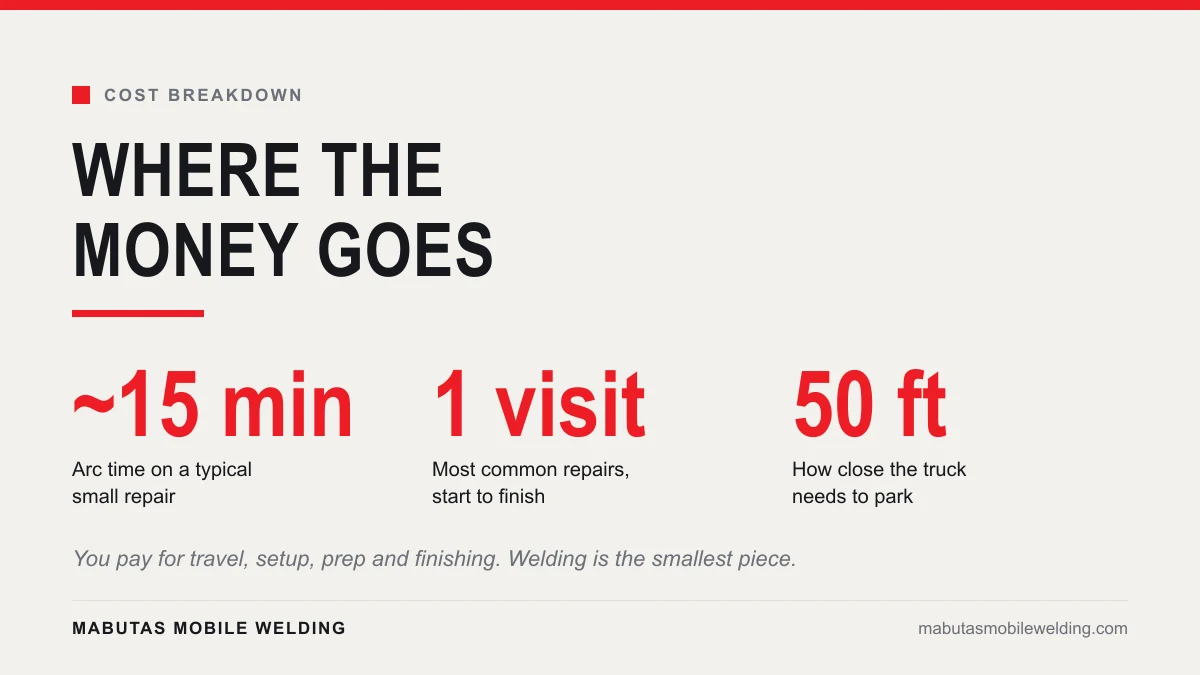
A mobile welding invoice is rarely one line. Understanding the parts tells you where your money goes and which parts you can influence.
These are typical DuPage market ranges for planning, not a quote. Your job moves within them based on access, metal, and finish.
| Job | Typical range | What moves it |
|---|---|---|
| Small repair: cracked bracket, broken hinge, snapped tab | Low hundreds | Access, whether paint has to come off, finish |
| Sagging or dragging gate | Low to mid hundreds | Whether the post is also failing, hardware replacement |
| Loose or wobbly iron railing | Low to mid hundreds | Number of anchor points, concrete condition, code requirements |
| Trailer frame or crossmember repair | Mid hundreds and up | Length of the crack, whether plating is needed, position |
| Heavy equipment repair, bucket or attachment | Mid hundreds and up | Steel thickness, wear plate, downtime urgency |
| Custom fabrication | Quoted per project | Design time, material, finish, whether it installs on site |
Where you are inside DuPage County does not move the ranges above much, but it does change what tends to break. Across the industrial north of the county the calls run to racking, dock plates, and trailer frames — that is most of what on-site welding in Bensenville and a mobile welder in Carol Stream get called out for — while the older residential streets further south generate more iron fence and railing work. Same rates, different job mix.
If the piece can be unbolted and thrown in a truck, a shop may quote less. If it is bolted to concrete, hung on posts, part of a structure, or too heavy to move, mobile is not a premium. It is the only way the job happens without a crane or a cutting torch.
The gap between a vague quote and an accurate one is about four pieces of information. Send these and most welders can give you a genuine range before driving out.
If a trailer is down, a gate will not close overnight, or a piece of equipment is stopped mid job, the calculation changes. The question is no longer what the weld costs, it is what the hour costs you.
A rented machine sitting idle, a crew standing around, or a delivery that cannot go out usually outruns the welding invoice quickly. That is the honest case for paying an emergency rate: not because the weld is better, but because the repair happens today instead of Thursday. If the downtime does not actually cost you anything, schedule it normally and pay less.
One thing worth knowing before you call: a temporary repair is a legitimate option. Getting a trailer safely off the road or a gate secured for the weekend, then doing the permanent fix on a scheduled visit, is often cheaper than forcing the full job into an emergency window.
You do not need a formal contract for a two hour repair, but a text or email with these five things protects both sides and takes two minutes to produce:
If a welder will not put a range in writing before driving out, that is information. It usually means the price gets decided once they are standing in your driveway and you have already committed your afternoon.
Welding hides its own defects. A weld with poor penetration, trapped porosity, or contamination from unprepared metal can look completely normal and fail under load months later. When it fails, you pay twice, once for the first attempt and again for someone to grind it out and do it properly, usually with more damage than the original problem.
The practical filter is not price, it is process. A welder who asks what the metal is, wants photos, mentions preparation, and tells you whether it can be done in place is describing a job they intend to do correctly. That is worth more than the lowest number on your list.
An honest welder will occasionally tell you not to hire them, and it is worth knowing when that answer is coming so you are not surprised by it.
Badly corroded steel is the common one. If a railing base or a trailer crossmember has rusted until there is no sound metal left to weld to, adding a bead just attaches new steel to something that is already failing beside it. Replacing the section costs more up front and is the only version that lasts.
Repeatedly cracked repairs are the other. When the same joint fails two or three times, the weld is usually not the problem. Something is flexing, loaded wrong, or undersized for the job, and fixing the symptom again just buys a few more months. The fix there is reinforcement or a redesign, which is fabrication work rather than a repair call.
Thin sheet metal on a cosmetic panel is the third. It can be welded, but warping is likely and the finish work often costs more than replacing the panel outright.
Mabutas Mobile Welding & Fabrication quotes from photos and works on site across Villa Park, Elmhurst, Lombard, Addison, Oak Brook, Hinsdale, Naperville and Wheaton. Most common repairs are completed in a single visit.
Sources: U.S. Bureau of Labor Statistics, Welders · American Welding Society · OSHA Welding, Cutting and Brazing
Pricing works the same across the county — see mobile welding in Glendale Heights.
The same rates apply in Wood Dale.